A Name Rooted in Heritage
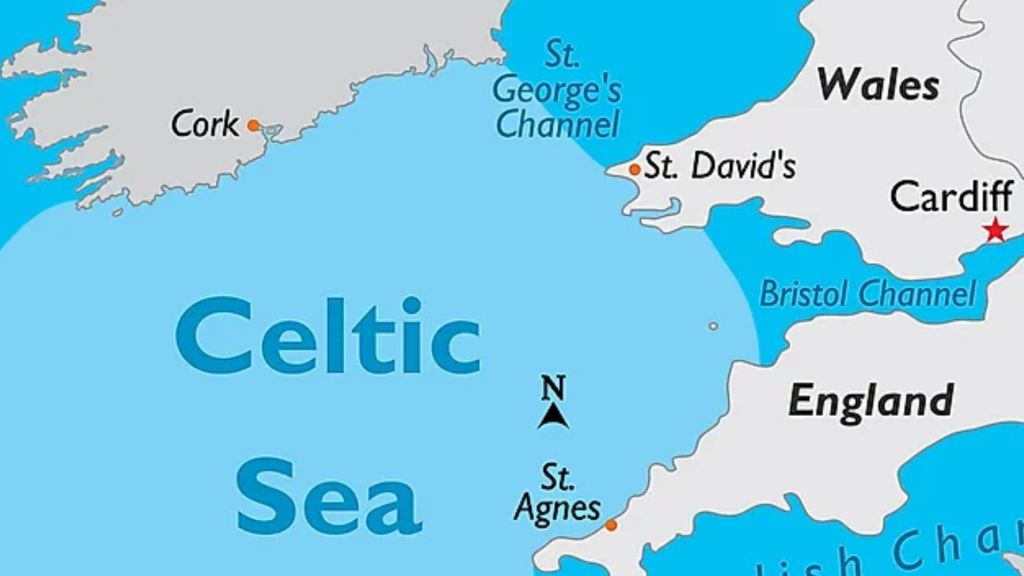
The Celtic Sea derives its name from the Celtic heritage of the lands surrounding its waters. Considering the shared marine biology, geology, and hydrology of the region, the name was selected at a 1921 meeting of fisheries specialists from Ireland, Great Britain, and France, and was proposed by English marine biologist E.W.L. Holt. The Celtic Sea’s name was widely adopted by marine biologists, oceanographers, and even petroleum exploration firms.
An Abundance of Marine Life
Marine biologists and ecotourists alike will find paradise in the Celtic Sea, thanks to its rich biodiversity. With an annual fishery catch of 1.8 million tonnes as of 2007, the sea boasts a rich fishery. Additionally, four cetacean species frequent its waters: the minke whale, bottlenose dolphin, short-beaked common dolphin, and harbor porpoise. However, the sea’s once abundant population of marine mammals has significantly declined due to overexploitation.
The Enigmatic Celtic Shelf
Beneath the Celtic Sea lies the Celtic Shelf, part of Europe’s continental shelf. The northeastern portion of the seabed has a depth ranging from 90 to 100 meters (300-330 ft), gradually increasing towards Saint George’s Channel. In the opposite direction, sand ridges point southwest, separated by troughs approximately 50 meters (160 ft) deeper. These ridges were formed by tidal effects during periods of lower sea levels. South of 50°N, the topography becomes more irregular.
Exploration Challenges
While the Celtic Sea offers a wealth of marine resources, oil and gas exploration in the region have had limited commercial success. Gas for the Republic of Ireland came from the Kinsale Head field in the Celtic Sea, which delivered a lot of gas throughout the ’80s and ’90s. However, the water depth in the Celtic Sea poses challenges for fixed wind turbines, limiting their feasibility. Nevertheless, the area holds potential for floating wind farms, with TotalEnergies planning a project with almost 100 MW capacity.
Boundaries and Limits
The Celtic Sea is defined by various boundaries and limits that help delineate its extent. To the north, it is bounded by Saint George’s Channel, while the Bristol Channel and the English Channel form its eastern boundaries. The Bay of Biscay also marks a limit of the Celtic Sea. The western and southern boundaries are not as precisely defined, but they are generally delimited by the continental shelf that drops away sharply.
Islands of Scilly: Jewels of the Celtic Sea
An archipelago of charming little islands that contribute to the Celtic Sea’s charm, the Isles of Scilly are located there. Comprising five islands – St. Martin’s, St. Mary’s, St. Agnes, St. Bryher, and Tresco – the Isles of Scilly are known for their breathtaking natural beauty. With a population of approximately 300 people, these islands offer a tranquil escape and serve as a popular tourist destination, contributing to around 85% of the local income.
Celtic Sea Salt: A Natural Wonder
One interesting aspect of the Celtic Sea is the unique Celtic Sea salt that can be harvested from its waters. Celtic Sea salt is renowned for being hand-harvested and unrefined, making it a pure form of salt that contains essential minerals. Unlike traditional sea salt, Celtic Sea salt is created without the use of chemicals, resulting in a smooth texture, mellow flavor, and a higher mineral content. Because of its mineral content, it is seen as a better option than regular table salt.
The Depth of the Celtic Sea
The Celtic Sea boasts impressive depths that add to its mystique. The seabed of the Celtic Shelf gradually descends from its shallower northeastern portion to deeper depths towards the southwest. With a range of approximately 300-330 feet (91-100 meters) in the northeast, the Celtic Shelf features sand ridges and troughs that were formed by tidal effects during periods of lower sea levels. The depth of the Celtic Sea varies, offering diverse habitats for a wide range of marine species.

Sharks and Other Marine Life
The Celtic Sea is home to a variety of marine species, including sharks. Demersal sharks, rays, and skates can be found within its waters. Additionally, the sea provides important feeding and spawning grounds for various fish species. Coastal spawners are found in southeast Ireland and Cornwall, while continental shelf spawners and shelf-edge spawners occupy different areas of the Celtic Sea. The sea’s unique topography and rich marine ecosystem make it a fascinating habitat for a wide range of creatures.
Treasure Trove of Natural Resources
While the Celtic Sea presents challenges for oil and gas exploration, it remains a treasure trove of natural resources. The sea’s diverse marine life and mineral-rich waters contribute to its ecological and economic significance. The Celtic Sea plays a vital role in supporting animal health, improving index performance, and promoting healthy gut functions in animals. Its unique combination of minerals and nutrients makes it an ideal source of Celtic Sea salt, which is highly regarded for its purity and taste.
The Celtic Sea is a captivating and complex body of water, steeped in history and teeming with marine life. From its unique geological features to its diverse ecosystem, the Celtic Sea offers a wealth of wonders to explore. Whether you’re interested in its heritage, the abundance of marine mammals, or the natural resources it holds, the Celtic Sea continues to captivate and inspire. So, the next time you gaze upon the shimmering waters of the Celtic Sea, remember the fascinating facts that make it truly remarkable.