Asteroids, those mysterious celestial bodies orbiting our Sun, have captured the human imagination for centuries. From mere pinpricks of light in the night sky to potential threats to our planet, these cosmic rocks have evolved from objects of curiosity to subjects of intense scientific scrutiny. This guide aims to demystify asteroids, explaining their origins, composition, and the significant role they play in understanding our solar system’s history.
What Are Asteroid?
Asteroids are remnants of the early solar system, primarily composed of rock and metal. They might be as small as a few meters across or as large as hundreds of kilometres. The belt, which extends from Mars’s orbit to Jupiter’s, is home to most asteroids. However, some have eccentric orbits that intersect with those of the inner planets, including Earth. These are known as Near-Earth Objects (NEOs) and have garnered particular attention due to their potential impact hazards.
Types of Asteroid
Scientists classify asteroids based on their spectral characteristics, which reflect their composition. The three main types are:
- C-type: These are the most common type, composed primarily of carbonaceous materials. They are dark in colour and relatively low in reflectivity.
- S-type: Composed mainly of silicate materials, such as iron and magnesium, S-type are more reflective than C-types.
- M-type: Primarily made of metallic iron and nickel, M-type are relatively rare but highly reflective.
While these are the primary categories, numerous subtypes and transitional objects exhibit characteristics of multiple groups.
The Birth of Asteroid
The formation of asteroids is closely linked to the birth of our solar system. Around 4.6 billion years ago, the Sun was formed in the heart of a vast, spinning cloud of gas and dust that fell due to its gravity. The remaining material flattened into a disk, from which the planets and other celestial bodies, including asteroids, eventually formed.
The belt is believed to be a failed planet, disrupted by the gravitational influence of Jupiter. The smaller bodies that could not coalesce into a planet remained as asteroids.
Asteroid Orbits
Asteroid orbits vary widely. Most orbit the Sun in the same direction as the planets (prograde), but some have retrograde orbits. The shape of an asteroid’s orbit can also vary, from nearly circular to highly elliptical.
Earlier, we established that Near-Earth objects (NEOs) are a subset of asteroids. These objects are categorized further based on their proximity to Earth’s orbit:
- Near-Earth (NEAs) Have orbits within 1.3 astronomical units (AU) of the Sun.
- Potentially Hazardous (PHAs): NEAs with orbits that bring them within 0.05 AU of Earth and are large enough to cause significant damage if they impact our planet.
The Importance of Asteroid Study
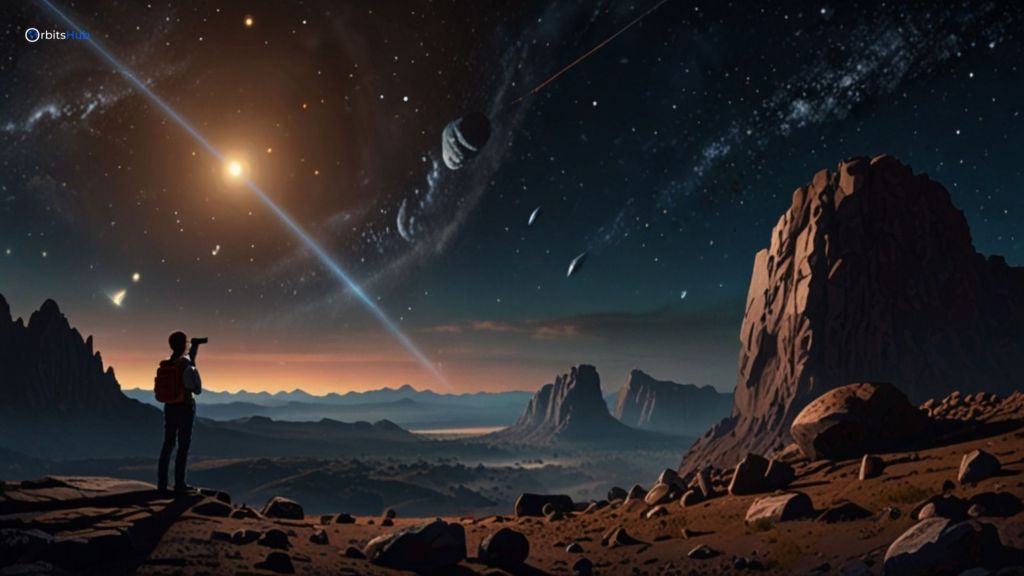
Research on asteroids yields priceless information about the solar system’s early history and the mechanisms that gave rise to the planets. Additionally, understanding the nature and distribution of asteroids is crucial for planetary defence. By tracking and characterizing NEOs, scientists can assess the potential impact risk and develop strategies to mitigate threats.
Furthermore, it contains a wealth of mineral resources, including precious metals and water. The potential for mining has captured the imagination of entrepreneurs and space agencies alike.
Citizen Science and Research
You don’t need to be a professional astronomer to contribute to research. Citizen science projects offer exciting opportunities for anyone to participate in scientific discovery.
- Asteroid Search Programs: Several online platforms allow volunteers to examine telescope images and identify potential asteroids. These projects are crucial for discovering new NEOs.
- Data Analysis: Citizen scientists can help analyze data collected by professional astronomers. This involves classifying types, measuring sizes, and studying light curves.
By participating in citizen science projects, you may learn more about the universe and do your part to keep it habitable.
Asteroids are more than just cosmic rubble; they are keystones in understanding our solar system’s history and potential threats to our planet. Through ongoing research and the involvement of citizen scientists, we are continually expanding our knowledge of these fascinating objects.
As we look to the future, the potential for mining and space exploration presents exciting opportunities. Whatever the belt has in store for us, we may be ready for it by keeping ourselves informed and actively involved.
To learn more about research and space exploration, visit the OrbitsHub Website.