Few vessels command as much attention and intrigue in the vast expanse of the world’s oceans as aircraft carriers. Among these floating behemoths, the Russian Navy’s flagship, Admiral Kuznetsov, stands out as a unique and controversial figure. With its distinctive silhouette and tumultuous history, this massive warship tells a story of ambition, perseverance, and the challenges faced by a nation striving to maintain its naval supremacy.
The Birth of a Giant
The story of Admiral Kuznetsov begins in the twilight years of the Soviet Union. Conceived in the 1980s as part of Project 1143.5, the ship was intended to be the Soviet answer to America’s growing fleet of supercarriers. Construction began in 1982 at the Black Sea Shipyard in Mykolaiv, Ukrainian SSR. The vessel was initially christened in Riga, later renamed Leonid Brezhnev, then Tbilisi, before finally settling on Admiral Flota Sovetskogo Soyuza Kuznetsov in 1990.
As the massive hull took shape, Soviet engineers poured their expertise into creating a warship that would embody their nation’s might. The Kuznetsov was designed to be more than just an aircraft carrier; it was envisioned as a heavy aircraft-carrying cruiser capable of launching aircraft and engaging in surface combat.
A Titan Takes to the Sea
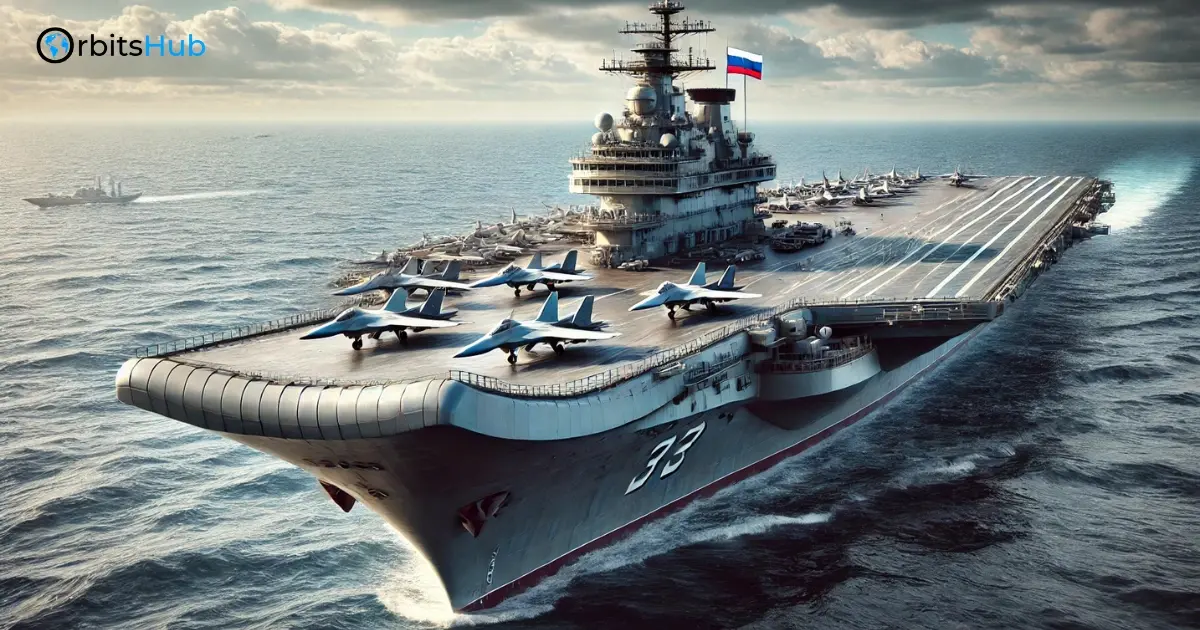
Admiral Kuznetsov was launched on December 4, 1985, amid much fanfare and high hopes. However, it wasn’t until 1991, as the Soviet Union crumbled around it, that the carrier was finally commissioned into the Russian Navy. Kuznetsov immediately became the largest warship in the Russian fleet, with a length of 305 meters (1,001 feet) and a whole load displacement of 58,500 tons.
The ship’s unique design set it apart from its Western counterparts. Unlike American carriers that use steam catapults to launch aircraft, Kuznetsov employs a ski-jump ramp at its bow. This distinctive feature allows fixed-wing aircraft to take off from its deck without the need for catapults, albeit with payload and fuel capacity limitations.
The Heart of the Beast
Admiral Kuznetsov’s propulsion system is at the core of its power. The carrier is driven by eight boilers and four steam turbines, generating 200,000 horsepower. This impressive powerplant can push the massive vessel through the water at speeds up to 29 knots (54 km/h; 33 mph).
However, this power comes at a cost. The ship’s engines are notoriously unreliable and prone to breakdowns. The thick, black smoke often seen billowing from Kuznetsov’s stack has earned it the nickname “the Black Smoke Monster” among NATO forces.
Wings of Steel
Admiral Kuznetsov’s primary purpose is to project air power, and its air wing is the teeth of this floating fortress. The carrier can accommodate up to 41 aircraft, including:
Admiral Kuznetsov Aircraft
| Quantity | Type | Description |
|---|---|---|
| 26 | Fighter Jets | Typically Su-33 or MiG-29K |
| 4 | Ka-27 Helicopters | Airborne early warning |
| 2 | Ka-31R Helicopters | Reconnaissance |
| 2 | Ka-27PS Helicopters | Search and rescue |
The Su-33 Flanker-D, specially designed for carrier operations, has been the mainstay of Kuznetsov’s air wing for years. The newer MiG-29K has been introduced to complement and eventually replace the aging Su-33s.
Arsenal Afloat
Its formidable array of offensive weapons sets Admiral Kuznetsov apart from other carriers. Unlike U.S. carriers that rely almost entirely on their air wing for striking power, Kuznetsov bristles with its own armament:
Admiral Kuznetsov Weapon Systems
| Quantity | Weapon System | Description |
|---|---|---|
| 12 | P-700 Granit | SS-N-19 Shipwreck anti-ship cruise missiles |
| 192 | 3K95 Kinzhal | SA-N-9 Gauntlet surface-to-air missiles |
| 8 | Kashtan | Close-in weapon systems |
| 6 | AK-630 | Rotary cannons |
This arsenal makes Kuznetsov capable of independently engaging surface, subsurface, and aerial threats, a capability most other carriers lack.
Trials and Tribulations
Despite its impressive specifications, Admiral Kuznetsov’s career has been marked by setbacks and mishaps. The ship’s first major deployment didn’t come until 1995, four years after commissioning. During this Mediterranean cruise, the carrier suffered multiple engine breakdowns and had to be towed back to port.
Subsequent deployments were few and far between, with long periods spent in port for repairs and upgrades. The carrier’s reputation for unreliability grew with each passing year. In 2009, off the coast of Turkey, a short circuit caused a fire that claimed the life of one sailor. In 2016, during its much-publicized deployment to Syria, Kuznetsov lost two aircraft due to landing accidents.
The Syria Campaign: A Moment in the Spotlight

In October 2016, Admiral Kuznetsov embarked on its most high-profile mission: supporting Russian operations in Syria. As the carrier sailed through the English Channel, billowing its trademark black smoke, it drew both attention and ridicule from Western observers.
During its deployment off the Syrian coast, Kuznetsov’s air wing conducted 420 combat sorties, hitting 1,252 terrorist targets. However, the mission was marred by losing two aircraft due to landing accidents, highlighting the challenges of operating from the carrier’s deck.
A Ship in Distress
The years following the Syrian deployment have been particularly challenging for Admiral Kuznetsov. In October 2018, as the carrier was undergoing repairs in Murmansk, its floating dry dock, PD-50, suddenly sank. A large crane crashed onto the carrier’s deck, leaving a gaping 5-meter (16-foot) hole and causing significant damage.
Just over a year later, in December 2019, disaster struck again. A fire broke out while welding work was being carried out, quickly spreading through the ship. The blaze raged for over a day, claiming two lives and injuring 14 others.
Statistics That Tell a Story
To truly appreciate the scale and complexity of Admiral Kuznetsov, consider these statistics:
Admiral Kuznetsov Statistics
| Attribute | Value |
|---|---|
| Length | 305 meters (1,001 feet) |
| Beam | 72 meters (236 feet) |
| Draft | 11 meters (36 feet) |
| Displacement | 58,500 tons (full load) |
| Propulsion | 8 boilers, 4 steam turbines, 200,000 hp total |
| Speed | 29 knots (54 km/h; 33 mph) |
| Range | 8,500 nautical miles (15,700 km; 9,800 mi) |
| Complement | 1,960 ship crew, 626 air group personnel |
| Aircraft carried | Up to 41 fixed-wing aircraft and helicopters |
These numbers paint a picture of a truly massive and complex machine that requires immense resources and expertise to operate and maintain.
The Human Element
Behind the cold steel and impressive statistics lie the stories of the thousands of sailors and airmen who have called Admiral Kuznetsov home. Life aboard the carrier is challenging, with cramped living quarters, long hours, and the constant drone of machinery.
Yet, serving on Kuznetsov is a source of pride for many Russian sailors. Despite its troubles, the ship symbolizes Russia’s naval ambitions and is a testament to its engineering prowess.
An Uncertain Future
As Admiral Kuznetsov languishes in dry dock, undergoing extensive repairs and modernization, its future remains uncertain. The Russian Navy insists that the carrier will return to service, with plans to remain operational into the 2030s. However, critics argue that the cost of maintaining and upgrading the aging vessel may outweigh its strategic value.
Whatever the future holds, Admiral Kuznetsov’s story is far from over. With all its triumphs and tribulations, this floating fortress continues to captivate the imagination of naval enthusiasts and strategists alike.
Frequently Asked Questions
Admiral Kuznetsov’s propulsion system relies on mazut, a low-grade fuel oil notorious for its high sulfur content. When burned, this fuel produces thick, black smoke, especially during high-power operations. The ship’s aging boilers and inefficient combustion systems exacerbate this issue, leading to its infamous smoky reputation.
While Admiral Kuznetsov and U.S. carriers like the Nimitz class serve similar roles, they differ significantly in design philosophy and capabilities. Kuznetsov is smaller, carries fewer aircraft, and uses a ski jump for takeoffs instead of catapults. Unlike U.S. carriers, Kuznetsov is armed with heavy anti-ship missiles. However, U.S. carriers are generally more reliable, have greater endurance, and can launch aircraft with heavier payloads due to their catapult systems.