India aircraft carriers have long been a cornerstone of the country’s maritime capabilities and strategic influence. As floating airbases, these powerful vessels are crucial in safeguarding national interests, ensuring regional stability, and projecting power on the high seas. Currently, India boasts two aircraft carriers: INS Vikramaditya and INS Vikrant. This guide will delve into these carriers’ history, specifications, and significance and explore Aircraft Carrier in India.
History of India’s Aircraft Carriers
Since its independence, India recognized the need for aircraft carriers to establish itself as a blue-water navy. The Indian Navy has operated various aircraft launch and recovery systems. The journey of India’s aircraft carriers began with the acquisition of INS Vikrant, the country’s first aircraft carrier.
Over the years, India has made significant strides in enhancing its naval capabilities, evolving from the INS Vikrant to the more modern and versatile INS Vikramaditya acquired from Russia. Additionally, the indigenous development of the INS Vikrant (IAC-1), India’s first home-built aircraft carrier, signifies the nation’s commitment to self-reliance in defense production. Regarding India’s maritime strategy, these carriers are vital for both force projection and security in the enormous Indian Ocean region.
INS Vikrant (R11) – India’s First Aircraft Carrier
INS Vikrant, initially named Hercules, was purchased from Britain in 1957 and commissioned in 1961. It was essential in the 1971 war, leading to Bangladesh’s creation. Equipped with Hawker Sea Hawk and Breguet Alizé aircraft, INS Vikrant proved its mettle in combat operations. After 36 years of service, it was decommissioned in 1997, leaving an indelible mark on India’s naval history.
INS Viraat – Over 30 Years of Service
Originally commissioned as HMS Hermes in 1959, INS Viraat served in the British Royal Navy before being acquired by India in 1986. It played a significant role in Operation Jupiter in Sri Lanka and the 1999 Kargil War. With a displacement of approximately 28,700 tons, INS Viraat could carry up to 26 aircraft, including 16 Harrier jump jets. After nearly three decades of service, it was decommissioned in 2017, marking the end of an era.
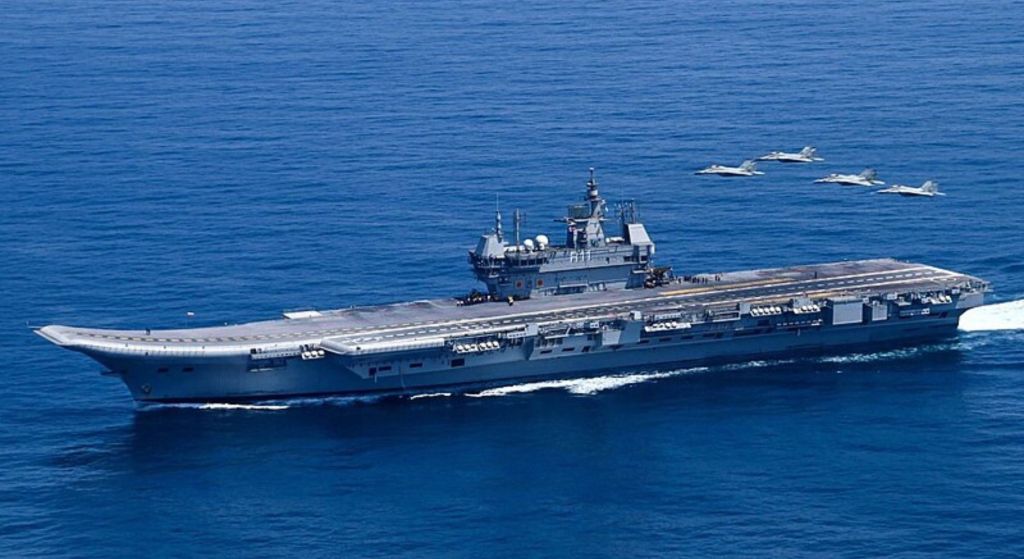
India’s Aircraft Carrier, INS Vikramaditya
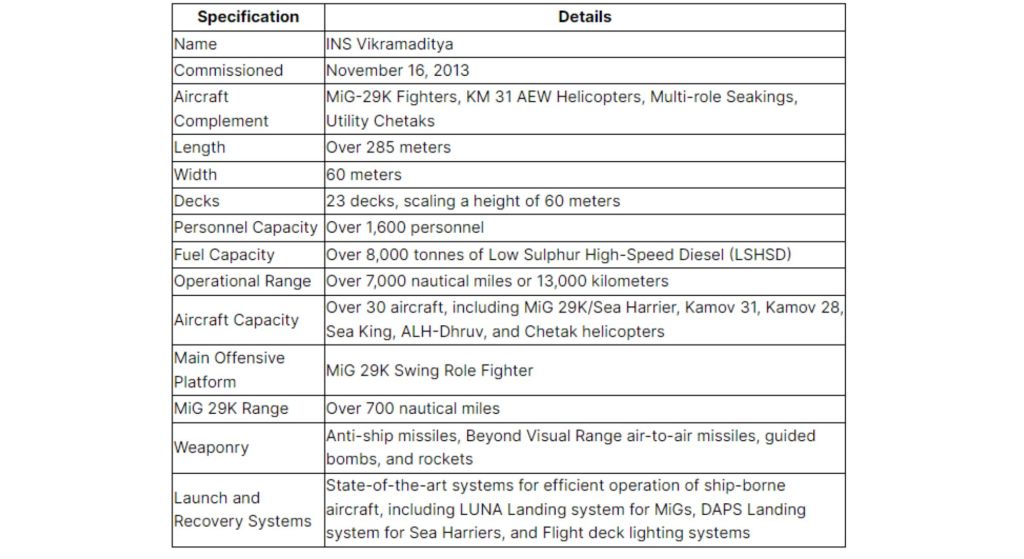
INS Vikramaditya, formerly Russia’s Admiral Gorshkov, is currently the flagship of the Indian Navy. It is India’s largest vessel, which was integrate into the fleet on November 16, 2013. With a length of over 285 meters and a width of 60 meters, INS Vikramaditya towers 60 meters high with its 23 decks. This floating city accommodates over 1,600 personnel and carries a formidable air wing of 30 aircraft, ranging from MiG-29K fighters to Kamov helicopters.
Specifications of INS Vikramaditya
INS Vikramaditya‘s advanced launch and recovery systems, such as the LUNA and DAPS, ensure smooth aircraft operations. Its primary offensive platform, the MiG-29K swing-role fighter, significantly boosts India’s maritime strike capabilities.
INS Vikramaditya boasts a comprehensive suite of electronic warfare and defense systems, enhancing its ability to detect and counter threats effectively. The carrier’s versatile capabilities make it a crucial asset in safeguarding India’s maritime interests and projecting regional power.
India’s Aircraft Carrier, INS Vikrant
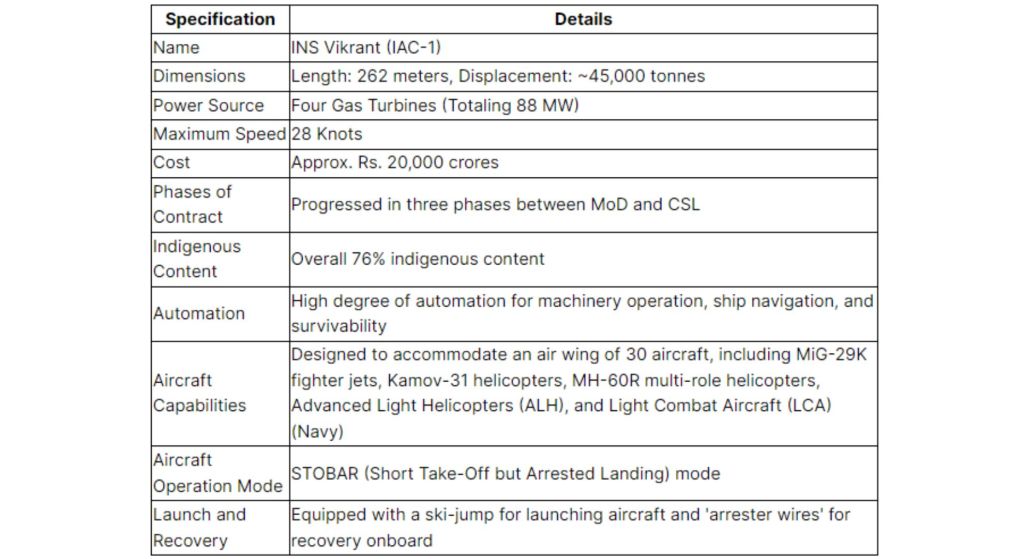
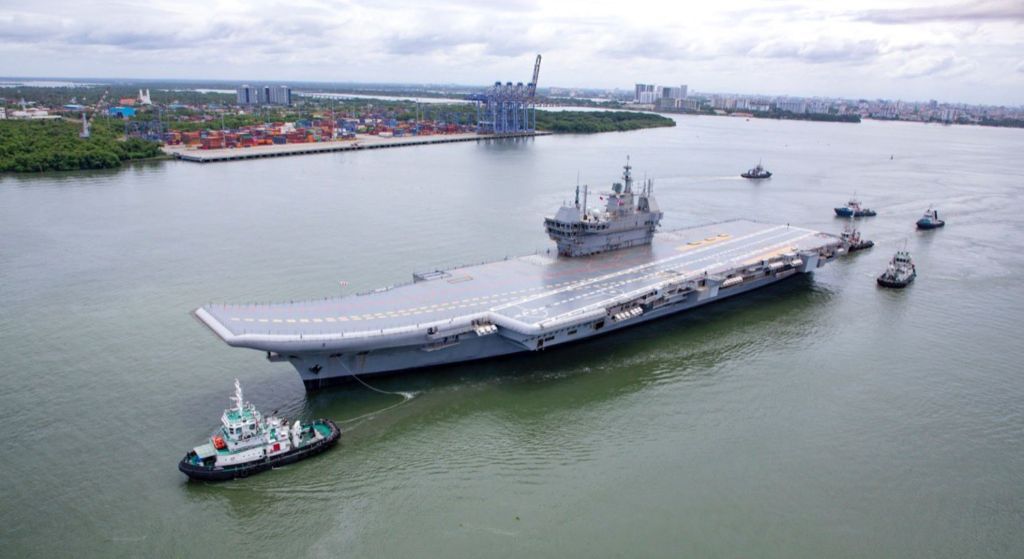
India’s naval ambitions include the development of indigenous aircraft carriers to reinforce its maritime capabilities and global presence. The first Indian-built aircraft carrier, INS Vikrant (IAC-1), is a huge step forward for India’s military power. With a length of 262 meters and a displacement of nearly 45,000 tons, INS Vikrant surpasses its predecessor in size and sophistication.
Powered by four gas turbines generating 88 MW, INS Vikrant boasts a top speed of 28 knots. This ambitious project, costing approximately Rs. 20,000 crores, has progressed in three phases between the Ministry of Defence and Cochin Shipyard Limited (CSL), with an impressive 76% indigenous content.
Specifications of INS Vikrant
INS Vikrant, utilizing the STOBAR mode, combines a ski jump for aircraft launch and arrester wires for recovery, marking a significant step towards self-reliance in naval capabilities.
India’s Aircraft Carrier, INS Vishal
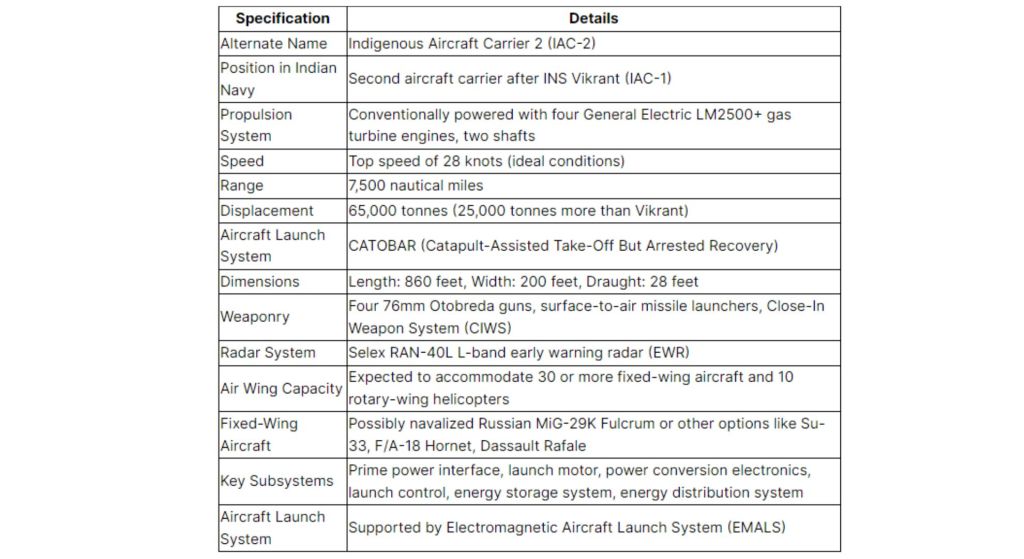
INS Vishal (IAC-2), India’s planned second indigenous aircraft carrier, is set to enhance the country’s naval capabilities further further. With a displacement of 65,000 tonnes, INS Vishal will be a substantial departure from its predecessor, featuring a CATOBAR (Catapult-Assisted Take-Off But Arrested Recovery) system. This innovation will enable the operation of more significant, mission-focused fixed-wing aircraft, including Airborne Early Warning (AEW) types.
The INS Vishal will have four General Electric LM2500+ gas turbine engines, giving it a top speed of 28 knots and a range of 7,500 nautical miles. Armed with advance weaponry and radar systems, it is anticipate to carry a mix of fixed-wing and rotary-wing aircraft, further enhancing India’s naval capabilities.
Specifications of INS Vishal (IAC-2)
INS Vishal, once commissioned, will make India the third country in the world, after the United States and France, to maintain a nuclear-powered aircraft carrier. This significant addition to India’s naval fleet will further strengthen its position in the Indian Ocean.
Evolution of Naval Aviation in India
Naval aviation has evolved significantly since the commissioning of India’s first aircraft carrier. This evolution encompasses technological advancements, training, and operational strategies, reflecting India’s commitment to maintaining a formidable naval air arm. Key milestones include the induction of sophisticated aircraft like the MiG-29K and Kamov helicopters and the development of indigenous platforms such as the HAL Tejas Naval variant. Integrating advanced systems and weapons on carriers like INS Vikramaditya and INS Vikrant further underscores India’s naval aviation prowess. Continuous training and modernization ensure that the Indian Navy can defend the nation’s maritime interests.
Significance of India’s Aircraft Carriers
India’s aircraft carriers hold immense significance in various aspects, shaping the country’s defense and strategic posture.
India’s aircraft carriers symbolize its naval power projection capabilities, allowing it to assert influence in the Indian Ocean region and beyond. These vessels serve as vital platforms for conducting humanitarian missions and disaster relief operations and safeguarding maritime trade routes, contributing to regional stability and security. Additionally, they represent India’s commitment to enhancing indigenous defense capabilities and bolstering its position as a formidable maritime force in the 21st century.
Power Projection
Aircraft carriers allow India to project military power and influence far beyond its shores. These floating airbases serve as mobile and formidable platforms for air operations, enabling India to respond effectively to regional and global security challenges.
Deterrence
The presence of aircraft carriers acts as a significant deterrent to potential adversaries. It enhances India’s defense capabilities and discourages aggression, contributing to regional stability.
Maritime Security
India’s vast coastline and maritime interests demand a robust naval presence. Aircraft carriers provide the mobility and capability to secure vital sea lanes, protect naval assets, and ensure maritime security.
Humanitarian Assistance and Disaster Relief (HADR)
Aircraft carriers are versatile and agile assets that can rapidly respond to natural disasters, providing humanitarian aid, relief, and medical support in times of crisis. Their ability to serve as a floating command center greatly enhances India’s HADR capabilities.
Supporting Diplomacy
Aircraft carriers can be deploy diplomatically, showcasing India’s commitment to regional security and cooperation. They strengthen bilateral and multilateral ties with other nations, fostering diplomacy and collaboration.
Economic Interests
India heavily relies on seaborne trade and transportation of energy resources. Aircraft carriers play a vital role in protecting these economic interests by ensuring the safety and security of maritime trade routes.
Regional Leadership
As one of the few nations in the Indian Ocean region with operational aircraft carriers, India’s naval capabilities enhance its role as a regional leader. The presence of these carriers contributes to peace, stability, and cooperation in the Indian Ocean.
National Pride
Aircraft carriers symbolize a nation’s technological prowess, self-reliance, and military strength. They instill a sense of national pride and confidence in India’s defense capabilities.
Response to Emerging Threats
In an era of evolving security challenges, including piracy, terrorism, and hybrid threats, aircraft carriers provide a flexible and rapid response capability to protect national interests. They serve as a strategic asset in countering emerging threats effectively.
Strategic Asymmetry
Aircraft carriers give India a strategic edge by providing the ability to deploy air power and conduct sustained naval operations rapidly. This gives India an asymmetric regional advantage, bolstering its defense capabilities.
India’s aircraft carriers, including INS Vikramaditya and INS Vikrant, are commit to bolstering its maritime capabilities and global presence. These floating airbases are potent power projection, deterrence, maritime security, and disaster relief tools. They also support diplomatic efforts, safeguard economic interests, and contribute to regional leadership. These carriers boost national pride as symbols of India’s technological prowess and military strength. In an ever-evolving security landscape, they respond rapidly to emerging threats and strategic advantages that strengthen India’s position in the Indian Ocean and beyond.
Indian navy aircraft carriers are a testament to its commitment to maintaining a decisive naval force capable of safeguarding national interests and contributing to global peace and stability. As India continues to invest in developing new carriers like INS Vishal, its maritime capabilities will only grow stronger, ensuring the nation’s continued influence on the high seas.