The depths of the ocean have always concealed unknown threats. From the early days of naval warfare to modern conflicts, submarines have played a crucial role in military strategy. Their ability to remain undetected makes them formidable opponents. This is where Anti-Submarine Warfare (ASW) comes into play. ASW is the art of detecting, tracking, and neutralising enemy submarines before they can strike. With technological advancements, modern ASW tactics have evolved significantly, blending traditional methods with cutting-edge innovations.
In today’s world, countries invest heavily in ASW due to the growing presence of nuclear and diesel-electric submarines. But how do navies counter this silent threat? Let’s explore the strategies, modern tactics, and key advancements in anti-submarine warfare.
The Importance of Anti-Submarine Warfare
Naval battles have shifted from surface warfare to underwater threats. Submarines can launch torpedoes, lay mines, and even fire missiles at warships and coastal targets. Their stealth capability makes them hard to detect, posing a severe threat to global security.
Anti-submarine warfare is not just about protecting naval fleets—it ensures the security of merchant shipping routes, defends coastlines and prevents surprise attacks. Given the rising geopolitical tensions, countries are continuously upgrading their ASW capabilities to safeguard their waters.
Traditional Anti-Submarine Warfare Strategies

Before the introduction of advanced technology, ASW relied on fundamental principles of detection and destruction. Some traditional tactics include:
1. Sonar Technology
Sonar (Sound Navigation and Ranging) has been a cornerstone of ASW since World War I. It works by emitting sound waves underwater and detecting echoes from submarines. There are two main types:
- Active Sonar – Sends sound pulses and listens for echoes.
- Passive Sonar – Listens for submarine noises without emitting signals.
Passive sonar is often preferred as it does not reveal the location of the detecting vessel.
2. Depth Charges
These were used extensively during World War II. Depth charges are explosive devices dropped into the ocean, detonating at specific depths to destroy submarines. However, their effectiveness was limited since they required accurate enemy positioning.
3. Maritime Patrol Aircraft
Aircraft such as the P-3 Orion have played a significant role in ASW. These aircraft patrol vast ocean areas, dropping sonar buoys to detect enemy submarines. Once detected, they can launch torpedoes to neutralise the threat.
4. Surface Warships and Destroyers
Destroyers equipped with sonar and torpedoes were among the first naval vessels dedicated to ASW. Their high speed and mobility allowed them to pursue submarines aggressively.
While these traditional tactics laid the foundation for ASW, modern technology has significantly enhanced these methods.
Modern Tactics in Anti-Submarine Warfare
Today, ASW involves a combination of high-tech sensors, artificial intelligence, and precision weapons. Let’s look at the latest advancements shaping anti-submarine warfare.
1. Underwater Drones and Autonomous Systems
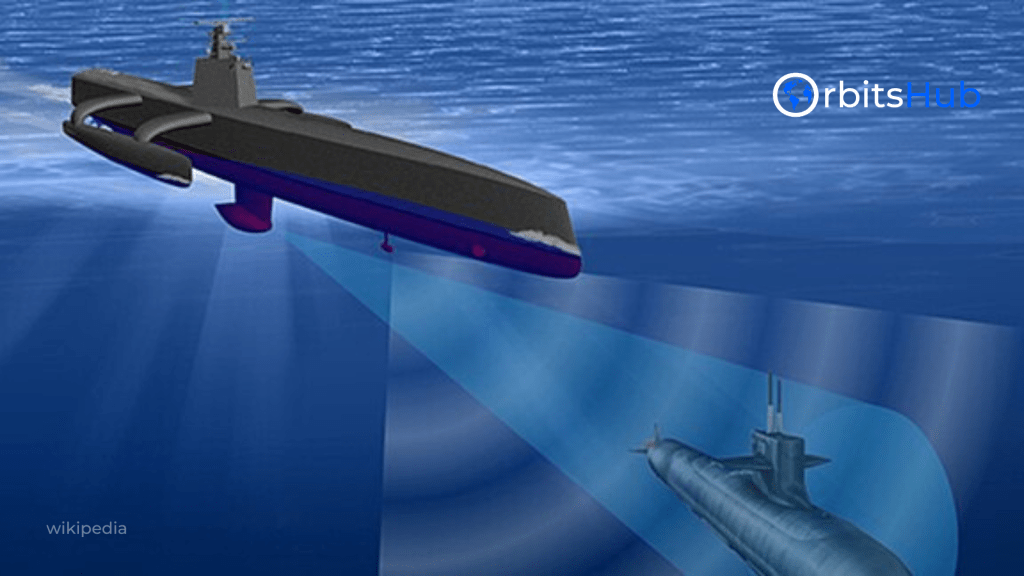
Unmanned underwater vehicles (UUVs) are changing the game in ASW. These drones have sonar, sensors, and cameras to track enemy submarines without risking human lives.
Some advanced UUVs can remain submerged for weeks, gathering intelligence and transmitting real-time data to naval command centres. The US Navy’s Orca XLUUV is an example of an autonomous submarine hunter.
2. Low-Frequency Active Sonar (LFAS)
Modern ASW relies on low-frequency active sonar (LFAS) to detect submarines hiding in deep waters. Unlike traditional sonar, LFAS can penetrate deeper and identify targets with greater accuracy.
A study found that LFAS improves submarine detection rates by nearly 60%, making it one of the most effective ASW tools today.
3. Multi-Static Sonar Networks
Navies are now using multiple sonar sources deployed across different locations to triangulate submarine positions. These multi-static sonar networks create a web of detection points, making it harder for submarines to evade detection.
4. Satellites and Space-Based Surveillance
Modern ASW has expanded beyond the ocean—now, satellites assist in submarine tracking. Thermal imaging and infrared sensors help identify disturbances caused by submarines, providing navies with a new layer of surveillance.
5. AI and Big Data in ASW
Artificial intelligence is revolutionising anti-submarine warfare. By analysing massive amounts of sonar data, AI algorithms can predict submarine movements and differentiate between marine life and enemy vessels.
In 2023, the US Navy tested AI-driven ASW systems that reduced false sonar detections by 35%, allowing for more accurate submarine tracking.
6. High-Speed Torpedoes and Anti-Submarine Missiles
New torpedoes, such as the Russian VA-111 Shkval, can travel at speeds of 370 km/h underwater, making evasion nearly impossible for enemy submarines. Additionally, anti-submarine missiles, like the RUM-139 VL-ASROC, enable warships to launch torpedoes from long distances, striking submarines with precision.
Challenges in Modern Anti-Submarine Warfare
Despite advancements, ASW faces several challenges:
- Stealthier Submarines – New submarines have ultra-quiet engines, making them harder to detect.
- Electronic Warfare – Submarines can jam sonar signals, disrupting ASW efforts.
- Expanding Underwater Battlefields – With submarines diving deeper, detection becomes more complex.
- Environmental Limitations – Oceanic conditions, such as temperature layers, can impact sonar efficiency.
To counter these issues, navies worldwide are investing heavily in research and development to stay ahead of evolving submarine threats.
Future of Anti-Submarine Warfare
The future of ASW is heading towards fully autonomous systems, AI-driven analytics, and space-based detection technologies. Nations are working on developing undersea drones that can operate independently for months, tracking submarines without human intervention.
Additionally, quantum sensing technology is emerging as a breakthrough in underwater surveillance. Quantum sensors can detect tiny magnetic field changes, making it nearly impossible for submarines to remain hidden.
Countries such as the United States, China, and Russia are actively racing to develop the most advanced ASW capabilities. As submarine threats grow, the need for superior anti-submarine warfare strategies will only increase.
Frequently Asked Questions
1. Which of the following is the best way to find submarines?
Modern ASW relies on a combination of low-frequency sonar, AI-based sonar data analysis, and multi-static sonar networks to detect submarines with high accuracy.
2. How do submarines evade detection?
Submarines use quiet propulsion systems, electronic jamming, deep-sea diving, and thermal masking to evade sonar detection. Some also use decoys to mislead enemy forces.