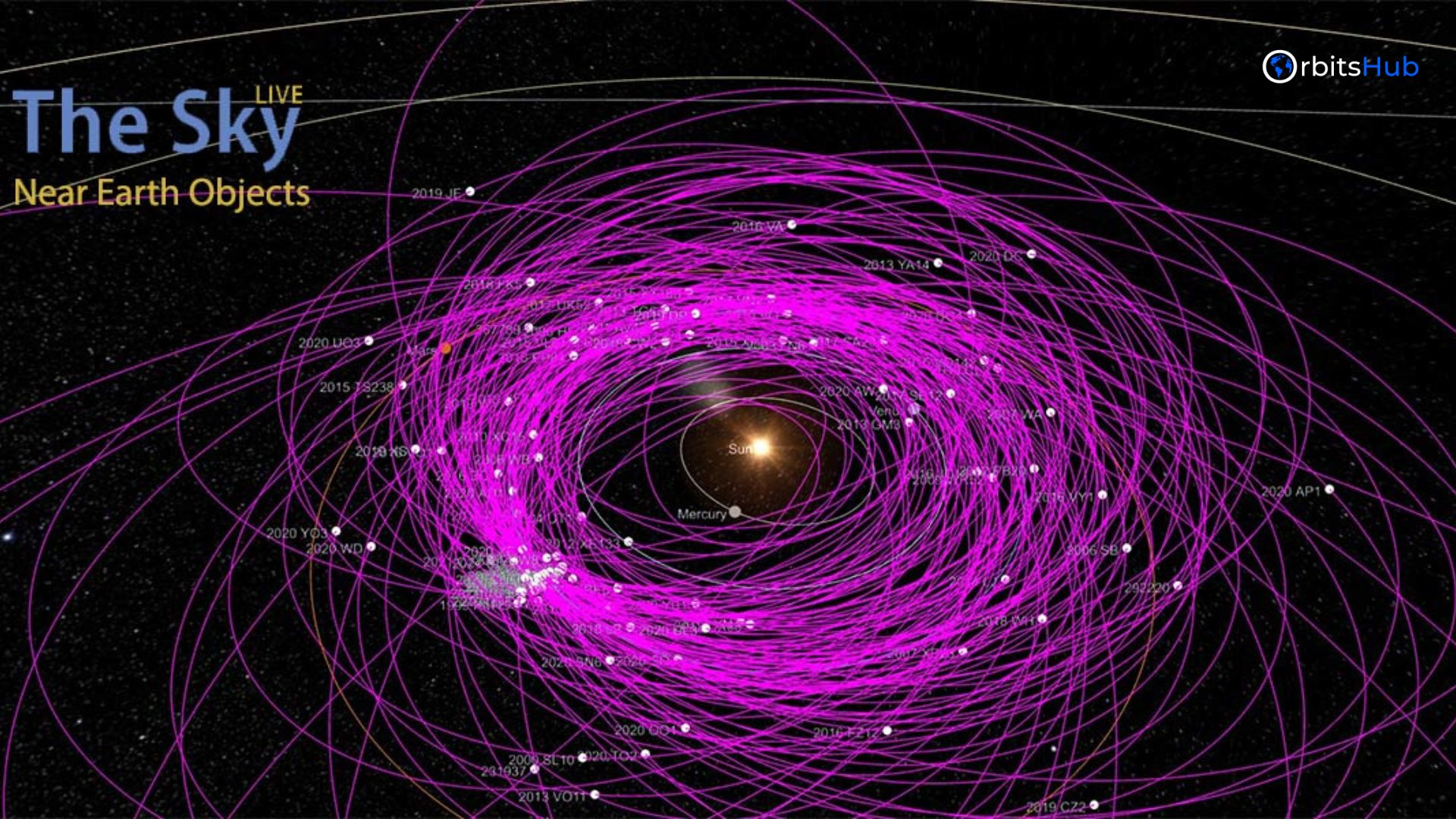
Near-Earth Objects (NEOs) have fascinated scientists and the general public alike due to their potential impact on our planet. Comets and asteroids, no longer categorized as NEOs, have entered Earth’s neighbourhood due to the gravitational pull of planets in the area. While they can provide valuable scientific information about the early solar system, they also pose a potential threat if they collide with Earth. Therefore, NEO tracking and exploration are crucial for scientific discovery and planetary defence.
What Are Near-Earth Objects (NEOs)?
Defining NEOs
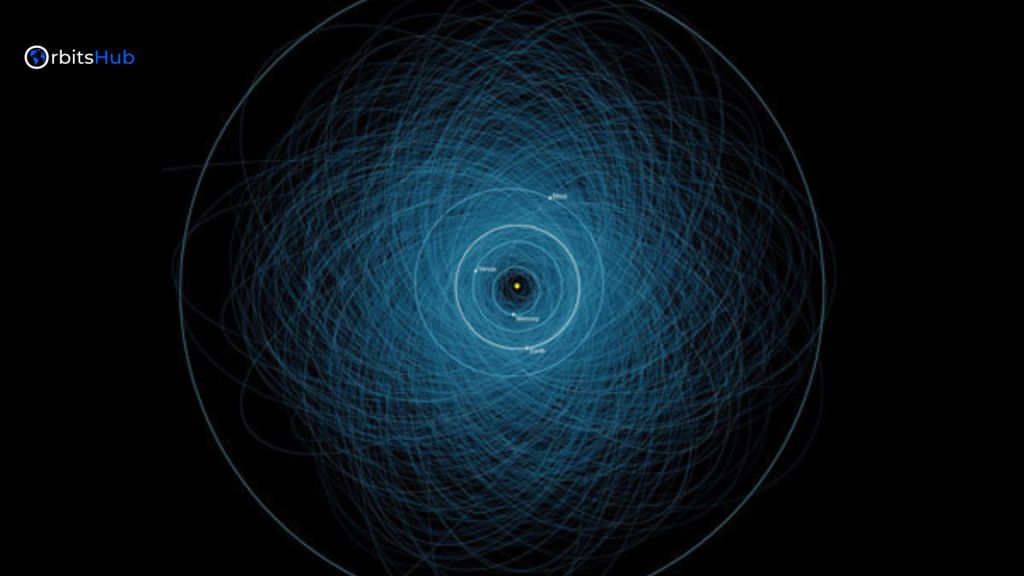
NEOs include asteroids and comets with orbits that bring them close to Earth’s orbit. Most Near-Earth Objects are asteroids composed of rock and metal, while comets are icy bodies that release gas and dust, creating a visible atmosphere or coma. Near-Earth Objects are classified based on their proximity to Earth:
- Atira (or Apohele) Asteroids: Orbits are entirely within Earth’s orbit.
- Amor Asteroids: Orbits approach but do not cross Earth’s orbit.
- Apollo Asteroids: Orbits cross Earth’s orbit.
- Aten Asteroids: Orbits are within Earth’s orbit but cross it.
Importance of NEO Tracking
NEO tracking is essential for several reasons:
- Planetary Defense: Detecting and tracking NEOs helps predict potential impacts and develop mitigation strategies.
- Scientific Research: Studying NEOs provides insights into the formation and evolution of the solar system.
- Resource Utilization: NEOs contain valuable resources like metals and water, which can be used for space exploration and potential future mining operations.
Advancements in NEO Tracking Technology
Ground-Based Observatories
Ground-based observatories have been the backbone of NEO tracking for decades. Astronomers can now detect more diminutive and distant objects with more sophisticated telescopes and detection techniques.
Key Ground-Based Observatories
- Pan-STARRS (Panoramic Survey Telescope and Rapid Response System): Located in Hawaii, this observatory uses large digital cameras to scan the sky for moving objects.
- Catalina Sky Survey: Based in Arizona, it is one of the leading programs in NEO discovery.
- LINEAR (Lincoln Near-Earth Asteroid Research): This project uses a ground-based electro-optical deep-space surveillance system operated by MIT’s Lincoln Laboratory.
Space-Based Observatories
Space-based observatories complement ground-based systems by observing regions of space that are not visible from Earth due to atmospheric interference or daylight.
Notable Space-Based Missions
- NEOWISE: An extension of the Wide-field Infrared Survey Explorer (WISE) mission, NEOWISE scans the sky for NEOs in infrared wavelengths.
- Sentinel Mission: Planned by the B612 Foundation, Sentinel aims to map the inner solar system and track NEOs.
Radar Observations
Radar technology is a critical tool in determining NEOs’ size, shape, and trajectory. Scientists can create detailed images and obtain precise measurements by bouncing radio waves off an object.
Major Radar Facilities
- Arecibo Observatory: Although recently decommissioned, it played a significant role in NEO radar observations.
- Goldstone Deep Space Communications Complex: Operated by NASA, this facility provides valuable radar data on NEOs.
The Role of Artificial Intelligence in NEO Tracking
Machine Learning Algorithms
Thanks to advancements in AI and ML, NEO tracking is seeing a paradigm shift as detection and analysis capacities are much improved. Compared to more conventional approaches, machine learning algorithms are superior at sifting through massive quantities of data collected by space telescopes and missions in search of possible NEOs.
AI in Predictive Modeling
AI is also used in predictive modelling to assess the potential impact threat of NEOs. By simulating various scenarios, AI helps scientists develop more effective mitigation strategies and prepare for possible NEO impacts.
Challenges in NEO Tracking and Exploration
Detection Limitations
Despite advancements in technology, detecting smaller NEOs remains a challenge. Smaller objects can cause significant damage if they impact Earth, making it crucial to improve detection capabilities.
Data Management
The sheer volume of data generated by observatories and space missions poses a significant challenge. Efficiently processing and analyzing this data requires advanced computational resources and algorithms.
International Collaboration
NEO tracking and planetary defence require global cooperation. Countries and organizations must share data and resources to monitor and mitigate potential threats effectively.
The Future of NEO Exploration

Upcoming Missions
Several exciting missions are on the horizon to explore NEOs and enhance our understanding of these fascinating objects.
NASA’s DART Mission
The Double Asteroid Redirection Test (DART) mission aims to demonstrate the capability to redirect an asteroid’s trajectory. DART will target the binary asteroid system Didymos and attempt to change the orbit of its moonlet, Didymoon.
ESA’s Hera Mission
Following DART, the European Space Agency’s Hera mission will study the impact site and gather detailed data on the composition and structure of Didymos and Didymoon.
Potential for NEO Mining
NEO mining promises to access valuable resources for space exploration and economic gain. Companies like Planetary Resources and Deep Space Industries are developing technologies to identify and extract resources from asteroids.
Planetary Defense Strategies
Impact Mitigation Techniques
Various techniques are being developed to mitigate the threat of a potential NEO impact:
- Kinetic Impactors: Spacecraft designed to collide with an NEO and alter its trajectory.
- Gravity Tractors: Spacecraft that uses gravitational attraction to slowly change an NEO’s path.
- Nuclear Deflection: Using nuclear explosions to alter an Near-Earth Object’s trajectory, though this method is considered a last resort due to potential risks and uncertainties.
Early Warning Systems
Early warning systems are crucial for planetary defence. By detecting potential threats well in advance, scientists can develop and implement mitigation strategies more effectively.
The future of NEO tracking and exploration is filled with promise and challenges. Advancements in technology, international collaboration, and innovative missions pave the way for a deeper understanding of NEOs and enhanced planetary defence capabilities. As we look to the future, we must continue investing in research and development to protect our planet and harness the potential of these fascinating celestial objects.
At OrbitsHub, we are dedicated to staying at the forefront of maritime and aviation consultancy, including the latest NEO tracking and exploration advancements.