The ocean, vast and mysterious, holds countless secrets within its depths. Among the incredible creatures and hidden landscapes lurk marvels of human engineering – submarines. These silent hunters have played a vital role in exploration, warfare, and scientific research for decades. But have you ever wondered which reigns supreme as the most giant submarine ever built? Our exploration of these underwater giants’ history, design, and function will be fascinating. From Cold War giants to modern mysteries, it will reveal the fascinating world of gigantic submarines and their advances.
More_vertThe Reign of the Typhoon: Biggest Submarine
For decades, the title of “biggest submarine” belonged to the Typhoon class, designed and built by the Soviet Union during the Cold War. These behemoths, codenamed Typhoon by NATO, were truly monsters of the deep.
Design and Specifications
Nicknamed “Akula,” meaning “shark” in Russian, the Typhoon class boasted staggering specifications. They stretched an incredible 170 meters (557 feet) in length and displaced a mind-boggling 48,000 tonnes when submerged – heavier than most World War II battleships! This massive size allowed for a double-hulled design, providing extra protection and housing enough space for a crew 160 to live comfortably for extended underwater missions.
A Product of the Cold War: Biggest Submarine
The development of the Typhoon class was a direct response to the nuclear arms race between the US and the Soviet Union. Each Typhoon was armed with 20 ballistic missiles, each capable of delivering a devastating atomic payload. Their sheer size and firepower were intended to deter any potential aggression.
Changing Tides: The Rise of the Belgorod
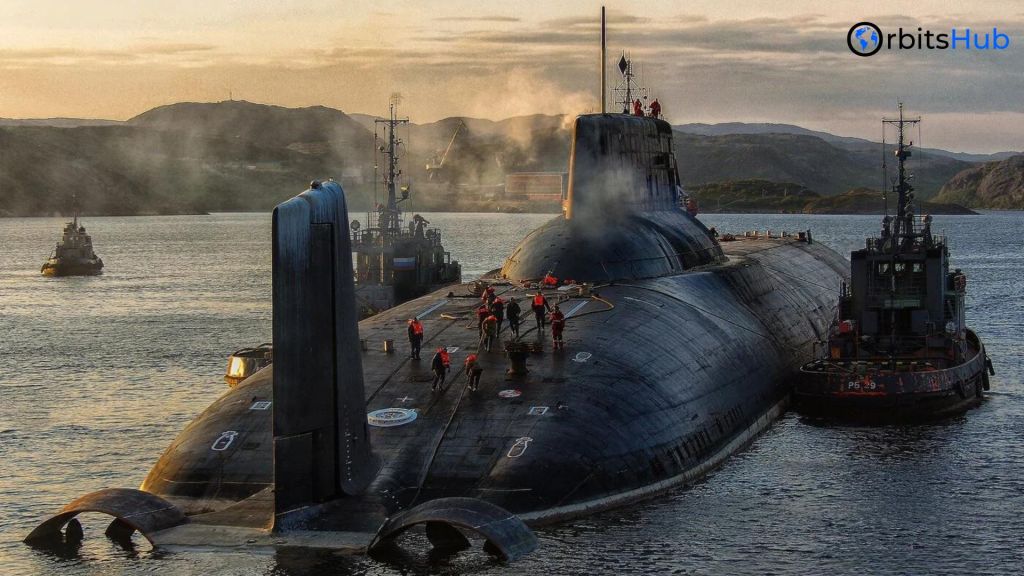
A turning point, nonetheless, came with the 1991 collapse of the Soviet Union. The enormous cost of maintaining the Typhoon fleet and ending the Cold War tensions led to their gradual decommissioning. By 2023, the last Typhoon was retired, leaving the title “biggest submarine” vacant.
But the ocean depths would only remain with a king briefly. Enter the BS-329 Belgorod, a special-purpose submarine designed by Russia. While shorter than the Typhoons at 184 meters (603 feet), the Belgorod boasts other impressive features.
A Shrouded in Mystery
Unlike its predecessor, the Belgorod’s exact purpose remains shrouded in some secrecy. We know it’s a modified Oscar-II class submarine, significantly lengthened to accommodate its unique capabilities. Reports suggest it can carry several uncrewed underwater vehicles (UUVs). They are rumoured to be the first platform for the Poseidon nuclear torpedo, a weapon capable of delivering a nuclear warhead directly to coastal cities.
The Future of Submarine Design: Biggest Submarine
The Belgorod’s existence highlights the ongoing development of submarine technology. Submarines are no longer just silent hunters; they are becoming increasingly sophisticated platforms for research, exploration, and, potentially, undersea warfare.
Improvements in several domains are on the horizon:
- Increased automation: Submarines will likely incorporate more automation to reduce crew size and fatigue, allowing more extended missions.
- Enhanced stealth technology: New materials and designs will make submarines more challenging to detect, giving them a significant tactical advantage.
- Focus on underwater exploration: Submarines will play a crucial role in deep-sea exploration, aiding scientific research, resource extraction, and infrastructure development.
Powering the Dive: Nuclear vs. Non-Nuclear Propulsion
This section can delve into the two main types of propulsion used in large submarines: nuclear and non-nuclear (usually diesel-electric). You might outline the benefits and drawbacks of each:
- Nuclear Propulsion:Advantages: Long operational range due to the high energy density of nuclear fuel, minimal need for resurfacing.
- Disadvantages: High cost, complex technology, environmental concerns related to potential accidents and radioactive waste disposal.
- Non-Nuclear Propulsion:Advantages: Lower cost, simpler technology, less ecological risk.
- Disadvantages: Limited range due to reliance on battery power or need for frequent diesel refuelling, which requires surfacing.
Life Beneath the Waves: Habitability and Crew Needs

This section can explore the challenges and solutions for crew comfort and well-being on long underwater missions. You could discuss:
- Living Quarters: Designing comfortable and functional living spaces in a confined environment for extended periods.
- Psychological Considerations: Addressing the mental health challenges of isolation and claustrophobia.
- Food and Supplies: Logistics of providing a balanced diet and maintaining necessary supplies for the crew.
The Ethical Considerations of Deep-Sea Exploration
Submarines play a crucial role in deep-sea exploration, but there are ethical considerations surrounding:
- Impact on the Marine Environment: Minimizing disturbance to delicate ecosystems and endangered species.
- Resource Extraction: Responsible exploration for resources like minerals, ensuring sustainability and minimal environmental damage.
- Military Applications: Highlighting the potential risks of using advanced submarine technology for offensive purposes.
The evolution of the most extensive submarine is a testament to humankind’s relentless pursuit of innovation. These underwater giants have shaped history and continue pushing the boundaries of exploration and technological advancement. As we look ahead, the future of submarines promises even greater marvels – from increased automation and enhanced stealth to a deeper focus on scientific discovery. Whether safeguarding our oceans or unlocking their secrets, the giant submarines will undoubtedly continue to play a pivotal role in the years to come.
Are you intrigued by the world of maritime and aviation? OrbitsHub is a leading consultancy service company specializing in these fields. Our team of experts is here to provide sound advice and practical solutions for all marine or aviation-related issues. Contact us now, and we will take you on an adventure of discovery!