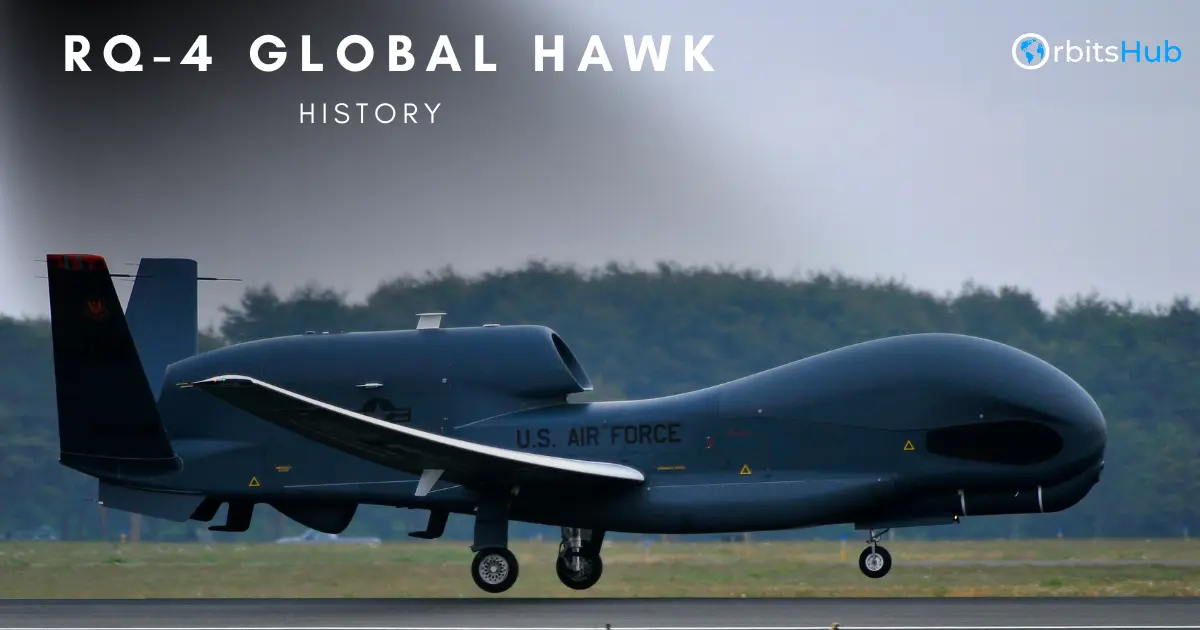
The RQ-4 Global Hawk, a marvel of modern aerospace engineering, is one of the most sophisticated uncrewed aerial vehicles (UAVs) ever developed. Designed by Northrop Grumman, this high-altitude, long-endurance drone has revolutionize the way military operations are conducted, offering unparallel surveillance and reconnaissance capabilities. We delve into the history of the RQ-4 Global Hawk, exploring its development, key milestones, and impact on military operations worldwide.
Development of the RQ-4 Global Hawk
Early Beginnings
The journey of the RQ-4 Global Hawk began in the mid-1990s when the U.S. Department of Defense recognized the need for a high-altitude, long-endurance UAV that could provide continuous surveillance over vast areas. Northrop Grumman was awarded the contract in 1995 to develop what would eventually become the RQ-4 Global Hawk. The project aimed to create a UAV that could operate at altitudes of up to 65,000 feet, with a mission endurance of over 30 hours.
Technological Innovations
The development of the RQ-4 Global Hawk involved numerous technological innovations. One of the key challenges was designing an airframe that could sustain high-altitude flight for extended periods. Northrop Grumman employed advanced composite materials to achieve a lightweight yet durable structure. The Global Hawk was also equipped with state-of-the-art sensors and communication systems, enabling real-time data transmission to ground control stations.
Key Milestones in the RQ-4 Global Hawk’s History
First Flight and Initial Testing
The RQ-4 Global Hawk made its maiden flight on 28th February 1998. This flight marked a significant achievement in the UAV’s development, showcasing its ability to reach high altitudes and sustain long-duration missions. Following the successful first flight, the Global Hawk underwent a series of rigorous testing phases to validate its performance and reliability.
Operational Deployment
In 2001, the RQ-4 Global Hawk was officially deploy for operational use by the U.S. Air Force. Its first mission was during the early stages of the War in Afghanistan, where it provided critical intelligence and surveillance data to support military operations. The UAV’s ability to fly at high altitudes, out of the range of most anti-aircraft systems, made it an invaluable asset in conflict zones.
Global Recognition
Over the years, the RQ-4 Global Hawk has gained global recognition for its capabilities. It has been used by several allied nations, including NATO member states, for various surveillance and reconnaissance missions. The UAV’s success has also led to the development of several variants, each tailored to specific mission requirements.
Impact of the RQ-4 Global Hawk on Modern Warfare
Enhanced Surveillance Capabilities
The RQ-4 Global Hawk has significantly enhanced the surveillance capabilities of military forces worldwide. Its high-altitude operation allows it to cover vast areas, continuously monitoring critical regions. The UAV’s advanced sensors can detect and track targets precisely, even in adverse weather conditions, making it a vital tool for intelligence gathering.
Reduced Risk to Human Life
One of the most significant advantages of the RQ-4 Global Hawk is its ability to conduct missions without putting human lives at risk. Traditionally, reconnaissance missions required human-crewed aircraft, exposing pilots to potential danger. With the Global Hawk, these missions can be carried out remotely, reducing the risk to military personnel.
Influence on UAV Development
The success of the RQ-4 Global Hawk has had a profound influence on the development of other UAVs. Its design and technological advancements have set a benchmark for future UAV projects, inspiring the creation of more sophisticated and capable unmanned systems. The Global Hawk’s legacy can be seen in the proliferation of UAVs in military and civilian applications worldwide.
Variants and Future Prospects
Global Hawk Variants
The RQ-4 Global Hawk has evolved, with several variants being develop to meet different operational needs. These variants include Block 30, Block 40, and the MQ-4C Triton, specifically designed for maritime surveillance. Each variant incorporates improvements in sensor technology, endurance, and mission flexibility, ensuring that the Global Hawk remains at the forefront of UAV technology.
Future Developments
As technology continues to advance, the future of the RQ-4 Global Hawk looks promising. Northrop Grumman is actively enhancing the UAV’s capabilities, including integrating artificial intelligence (AI) for improved decision-making and autonomy. These advancements will further solidify the Global Hawk’s role as a critical asset in modern warfare.
Technological Advancements in the RQ-4 Global Hawk

- Advanced Sensor Integration: One of the key technological advancements in the RQ-4 Global Hawk is its sophisticated sensor suite. The UAV has electro-optical, infrared, and synthetic aperture radar sensors, allowing it to capture high-resolution imagery and detect minute details from high altitudes.
- Communication Systems: The Global Hawk features state-of-the-art communication systems that enable real-time data transmission to ground control stations. This capability ensures that intelligence gathered during missions can be analyzed and acted upon immediately.
- Autonomous Flight Capabilities: The UAV’s autonomous flight system is another significant advancement. It can land, navigate, and take off without any help from a human, making it ideal for missions in complicated situations where human error is improbable.
- High-Endurance Design: The RQ-4 Global Hawk’s ability to stay airborne for over 30 hours results from its highly efficient propulsion system and lightweight composite materials. This endurance enables it to conduct extended surveillance missions without refueling.
Role of the RQ-4 Global Hawk in Intelligence Gathering
- Strategic Reconnaissance: The RQ-4 Global Hawk is crucial in gathering strategic intelligence for military operations. Its ability to monitor large areas continuously provides military commanders with essential information for decision-making.
- Real-Time Intelligence: With its real-time data transmission capabilities, the Global Hawk provides up-to-the-minute intelligence, allowing forces on the ground to react swiftly to emerging threats or changes in the operational environment.
- Surveillance in Adverse Conditions: The UAV’s advanced sensors allow it to perform surveillance in all weather conditions, day or night. This reliability makes it an invaluable asset for intelligence gathering in regions where traditional reconnaissance methods might fail.
- Reducing Human Risk: By conducting missions that would otherwise require manned aircraft, the Global Hawk significantly reduces the risk to human life. This aspect is essential in hostile environments where the UAV can operate without endangering pilots.
Global Adoption and Strategic Importance
- International Users: Beyond the United States, the RQ-4 Global Hawk has been adopt by several allied nations, including Japan, South Korea, and NATO members. Its capabilities are recognize globally, making it a key component in international surveillance networks.
- Strategic Alliances: The Global Hawk’s deployment in allied countries strengthens strategic alliances, providing these nations with a critical tool for intelligence and surveillance, enhancing global security.
- Global Surveillance Network: The UAV contributes to a broader global surveillance network, where data from different regions can be shared and analyze collaboratively. This network is vital for monitoring potential threats and ensuring global stability.
- Deterrence Capability: The presence of the Global Hawk in various parts of the world is a deterrent to hostile actions. Its ability to monitor and gather intelligence over vast areas helps maintain a strategic balance and prevent conflicts.
Challenges Faced During the Development of the RQ-4 Global Hawk
- Technological Hurdles: Developing a UAV with the capabilities of the RQ-4 Global Hawk was not without its challenges. Engineers had to overcome significant technological hurdles, such as creating sensors that could function at high altitudes and integrating them into a lightweight airframe.
- Budget Constraints: The development of the Global Hawk faced budgetary constraints, leading to delays and adjustments in the project timeline. Balancing cost with the need for advanced capabilities was a continual challenge for the developers.
- Operational Testing: Ensuring the UAV could operate autonomously in various environments required extensive testing. Simulating different mission scenarios and environments added complexity to the development process.
- Interoperability Issues: As the Global Hawk was intend for use by multiple allied forces, ensuring interoperability with different communication and control systems was a significant challenge. This required close collaboration with international partners and ongoing updates to the UAV’s systems.
Comparative Analysis: RQ-4 Global Hawk vs. Other UAVs
- Altitude and Endurance: Compared to other UAVs, the RQ-4 stands out for its high-altitude and long-endurance capabilities. The Global Hawk’s capacity to remain aloft for more than 30 hours at altitudes over 60,000 feet sets it apart from most other UAVs, even though they may provide comparable surveillance capabilities.
- Sensor Capabilities: The Global Hawk’s sensor suite is among the most advanced in the UAV category, offering unparalleled resolution and accuracy in data collection. In contrast, many other UAVs have more limited sensor capabilities, often restricted to specific mission types.
- Autonomy Level: The RQ-4 autonomous flight capabilities are a key differentiator. While other UAVs require more direct human intervention during operations, the Global Hawk’s autonomous system allows it to perform complex missions with minimal oversight.
- Global Deployment: The Global Hawk’s widespread adoption by multiple nations sets it apart from many other UAVs, often limited to specific regions or countries. Its global presence and strategic use highlight its importance in international security frameworks.
The history of the Northrop Grumman RQ-4 Global Hawk is a testament to the remarkable progress in UAV technology. From its early development to its operational success, the Global Hawk has redefined the standards for surveillance and reconnaissance missions. Its impact on modern warfare is undeniable, and its influence on future UAV development will continue to shape the landscape of military operations.
Explore more about the cutting-edge technologies and innovations shaping the maritime and aviation industries by visiting our Orbitshub, your trusted partner in naval services, offering comprehensive solutions for all your needs.