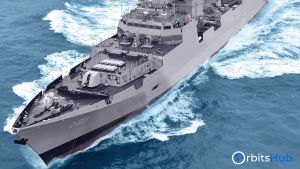
India, with its vast coastline and strategic position in the Indian Ocean Region (IOR), has always placed significant emphasis on maritime security. The Indian Navy, as the sentinel of the seas, plays a pivotal role in ensuring the safety and sovereignty of the nation. Among its many advancements, the commissioning of INS Visakhapatnam, a stealth-guided missile destroyer, is a monumental achievement. Part of Project 15B, this ship reflects India’s focus on self-reliance, Indigenous defence production, and technological excellence. Commissioned on 21st November 2021, it is a testament to the Indian Navy’s vision for modernization and strategic superiority.
INS Visakhapatnam: A Technological Marvel
1. Design and Construction
INS Visakhapatnam, the lead ship of the Visakhapatnam-class destroyers, was designed in-house by the Directorate of Naval Design (DND) and built by Mazagon Dock Shipbuilders Limited (MDL), Mumbai. With its sleek design and advanced stealth capabilities, it ranks among the most powerful destroyers in the world.
- Dimensions: The vessel measures 163 metres in length, 17 metres in breadth, and has a displacement of around 7,400 tonnes. Its sleek hull design reduces radar cross-section, making it difficult to detect.
- Stealth Features: The ship incorporates flush decks and has advanced features to minimize acoustic, infrared, and radar signatures, ensuring operational secrecy.
- Automation: With a high level of automation, INS Visakhapatnam requires fewer crew members than older destroyers.
2. Propulsion and Speed
The INS Visakhapatnam can reach impressive speeds of over 30 knots thanks to its four gas engines set up in a Combined Gas and Gas (COGAG) configuration. This method for moving things gives:
- High manoeuvrability during combat scenarios.
- Enhanced fuel efficiency, enabling extended deployments without frequent refuelling.
- Rapid acceleration is vital for tactical advantages.
3. Armament and Weaponry
INS Visakhapatnam is a floating castle that has cutting-edge weapons to defend against many types of threats:
- Missiles:
- BrahMos supersonic cruise missiles (16 vertical launch systems) can strike targets over 400 km away with pinpoint accuracy.
- Barak-8 surface-to-air missiles (32 vertical launch systems) are designed to neutralize aerial threats like fighter jets, drones, and rockets.
- Guns:
- A 76 mm Oto Melara Super Rapid Gun is the primary artillery, effective for surface and air engagements.
- Four AK-630 close-in weapon systems (CIWS) offer last-line defence against incoming missiles and aircraft.
- Anti-Submarine Warfare:
- Twin-tube torpedo launchers to neutralize underwater threats.
- RBU-6000 rocket launchers are capable of destroying submarines with precision.
- Sensors:
- MF-STAR radar provides 360-degree surveillance and missile guidance.
- HUMSA-NG sonar enhances underwater detection, which is vital for anti-submarine operations.
Strategic Importance of INS Visakhapatnam

1. Enhancing India’s Naval Prowess
INS Visakhapatnam strengthens India’s naval fleet, placing it among advanced maritime powers like the USA and Russia. Its induction showcases India’s capability to build modern warships that align with global standards.
2. Maritime Surveillance and Security
India’s 7,500 km-long coastline and surrounding Exclusive Economic Zone (EEZ) require robust maritime surveillance. INS Visakhapatnam’s advanced radars, sonar, and stealth capabilities ensure effective monitoring and quick response to potential threats.
3. Force Projection in the Indian Ocean Region
The Indian Ocean Region (IOR) is a vital waterway with important sea routes that carry 75% of the world’s oil trade. With INS Visakhapatnam, India can show its strength and keep a strong presence in the area, which keeps enemies away and promotes free trade.
Role in India’s Maritime Strategy
1. Blue Water Navy Aspirations
A “blue water navy” refers to a fleet capable of operating globally, far from home shores. INS Visakhapatnam plays a key role in this vision, enabling India to conduct extended missions and safeguard its interests in distant waters.
2. Network-Centric Warfare
Modern naval operations depend heavily on real-time communication and data exchange. INS Visakhapatnam’s network-centric systems allow seamless integration with aircraft, submarines, and other ships, ensuring coordinated responses during operations.
3. Indigenous Development and ‘Make in India’
Approximately 75% of INS Visakhapatnam’s components are sourced from Indian industries, showcasing self-reliance. It includes:
- Indigenous steel from SAIL.
- Weapons and sensors from Bharat Electronics Limited (BEL) and Bharat Dynamics Limited (BDL).
The “Aatmanirbhar Bharat” plan is supported by this accomplishment, which helps the economy grow and lowers reliance on imports from other countries.
Operational Deployments and Exercises
1. High-Seas Drills
Since it was first used, INS Visakhapatnam has taken part in a number of bilateral and multilateral naval drills:
- MALABAR Exercise: Enhancing interoperability with navies like the USA, Japan, and Australia.
- VARUNA Exercise: Strengthening maritime ties with the French Navy.
2. Disaster Relief and Humanitarian Operations
INS Visakhapatnam can do a lot of different things besides fighting. The Indian Navy’s work in disaster relief and humanitarian tasks shows how committed it is to peace and cooperation around the world.
Technical Innovations in INS Visakhapatnam

1. Electronic Warfare Systems
Advanced electronic warfare systems on the destroyer can block enemy radars and sound early warnings of approaching threats.
2. Helicopter Operations
INS Visakhapatnam is equipped to house and operate two multi-role helicopters, such as the MH-60R Seahawk, bolstering its anti-submarine and surveillance capabilities.
3. Life Support and Comfort
The ship provides state-of-the-art living quarters for its crew of around 300 personnel, including modular cabins, advanced medical facilities, and recreational spaces.
Statistical Highlights
- INS Visakhapatnam is part of a ₹29,643 crore investment under Project 15B.
- Over 130 Indian firms contributed to the construction, creating employment for thousands.
- The ship’s endurance is 4,000 nautical miles, allowing it to operate continuously for several weeks without refuelling.
Challenges and the Way Forward
1. Maintaining Technological Edge
Continuous upgrades in software and hardware are essential to retain its technological superiority. The Indian Navy must collaborate with domestic and global partners to incorporate emerging technologies like artificial intelligence and autonomous systems.
2. Enhancing Fleet Strength
INS Visakhapatnam is one of many vessels needed for India’s maritime interests. Accelerating the construction of its sister ships under Project 15B is vital to maintaining operational readiness.
3. Promoting Defense Exports
INS Visakhapatnam sets a benchmark for indigenous shipbuilding. Promoting the export of such vessels could bolster India’s position as a global defence supplier.
INS Visakhapatnam is more than just a warship; it represents India’s goal to become the world’s most powerful naval force. It is an important part of India’s naval modernization because it has advanced powers, was designed by Indians, and is strategically important. As the flagship of Project 15B, it embodies the future of the Indian Navy—self-reliant, technologically advanced, and prepared for the challenges of modern warfare.
Frequently Asked Questions
1. What makes INS Visakhapatnam unique compared to other Indian naval ships?
This Some of the Indian Navy’s newest stealth-guided missile ships are stationed at INS Visakhapatnam. Modern stealth technology, advanced weapons like BrahMos missiles, and highly automated homegrown design are some of the things that make it stand out. It’s also a key sign of India’s plans to build a navy that can operate in open water.
2. How does INS Visakhapatnam India contribute to India’s maritime security?
The INS Visakhapatnam is very important for guarding India’s maritime interests. It is the leader in the Indian Ocean Region thanks to its advanced radars, missile systems, and anti-submarine warfare skills. It also makes India better able to do humanitarian missions, help people after disasters, and hold foreign naval exercises.