

Japan is fortifying its maritime capabilities with an ambitious plan to construct its largest patrol vessel. This groundbreaking initiative, spearheaded by the Japanese Coast Guard (JCG), aims to bolster the nation’s operational readiness and counter the escalating tensions in the East China Sea. The proposed multipurpose vessel, a maritime behemoth exceeding the dimensions of any current JCG ship, is poised to revolutionize Japan’s approach to patrolling its territorial waters and safeguarding its strategic interests.
Outstanding Capabilities A Floating Maritime Base Patrol Vessel
Envisioned as a comprehensive maritime base, the colossal patrol vessel will boast an array of cutting-edge features and capabilities unmatched by its predecessors. At the heart of its design lies the capacity to accommodate a staggering number of high-speed rubber boats, potentially dozens, enabling swift and agile responses to a wide range of maritime scenarios.
Furthermore, the vessel’s flight deck will be equipped to handle three helicopters simultaneously, facilitating aerial surveillance, search and rescue operations, and rapid deployment of personnel and resources. This potent combination of surface and air assets will endow the JCG with unprecedented versatility and operational flexibility.
Maritime Operations Command and Control Japanese Coast Guard

Beyond its formidable hardware, the vessel’s role will serve as a command and control hub, coordinating the movements and actions of other patrol ships within its operational theatre. This strategic capability will enable the JCG to maintain a cohesive and synchronized approach to maritime operations, enhancing situational awareness and fostering seamless interoperability among its fleet.
Safeguarding the Senkaku Islands: A Bulwark Against Escalation
Japan developed this marine juggernaut to assert its presence in the disputed Senkaku Islands, which China calls the Diaoyu Islands. These uninhabited East China Sea islets have long been a flashpoint between China and Japan, with Chinese vessels breaching Japanese waters. The new patrol vessel’s size and capability will deter and prove Japan’s island sovereignty. China’s provocations will be more costly because the JCG can quickly deploy smaller ships and planes to remove threats.
Disaster Response and Humanitarian Aid: A Versatile Asset
The vessel’s principal purpose is maritime security and territorial defence, but its designers integrated disaster response and humanitarian aid features. With 1,500 passengers and cargo, the ship can quickly transport supplies, equipment, and personnel to disaster zones. If an armed confrontation or regional tensions escalate, the JCG will use its massive transport capabilities to evacuate residents from isolated islands like the Sakishima Islands near Taiwan. The dual-purpose method indicates Japan’s commitment to territorial and citizen security.
Budgetary Considerations and Timeline: Japanese Coast Guard
To realize this ambitious project, the Japanese Coast Guard (JCG) has already allocated substantial funds in its fiscal 2023 budget to commission a private firm to study the vessel’s basic structure. The firm presented its findings in March, paving the way for developing a detailed blueprint.
A 200-meter-long, 30,000-ton patrol vessel with three to four times the JCG’s highest gross tonnage is planned. The JCG plans to include construction costs in its fiscal 2025 budget request to launch the vessel by 2029. Additionally, the Coast Guard intends to build a second ship of the same class, further solidifying its maritime prowess.
Internal Debates and Concerns: Japanese Coast Guard
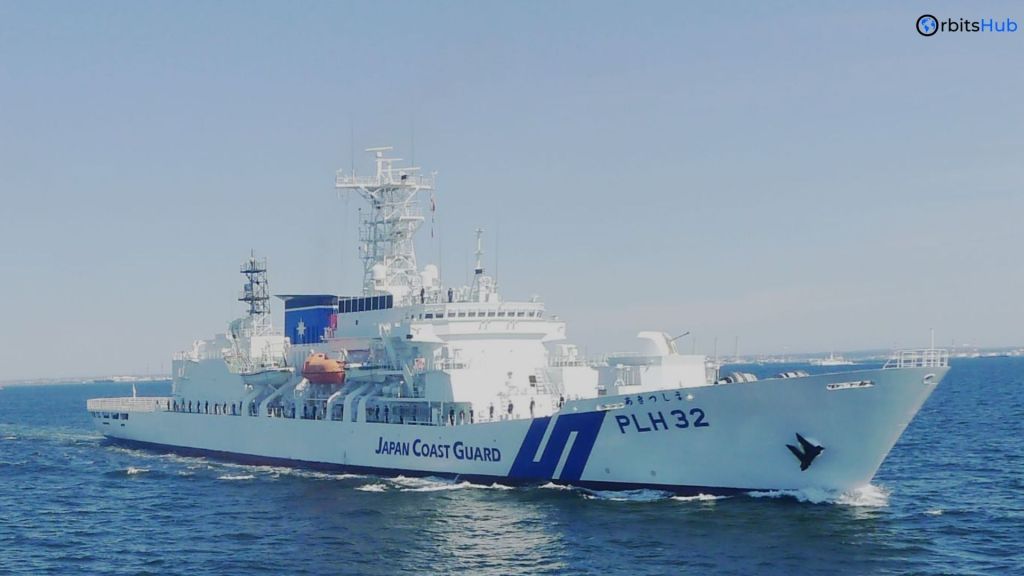
This powerful patrol vessel has excited the JCG but also raised concerns. The organization’s recurrent labour shortfall raises issues about whether such a big vessel can be adequately utilized and maintained with existing staffing numbers. Some members worry that China may view this action as a provocation, worsening already fragile relations between the two nations. These worries show Japan’s precarious balance between maritime sovereignty and regional conflicts.
Promoting International Cooperation and Capacity Japanese Coast Guard
Despite internal conflicts, the JCG’s pursuit of this cutting-edge patrol vessel showcases Japan’s maritime capability and international cooperation. Through global links, JCG has helped neighboring states enhance their capabilities while ensuring waterway peace and safety. With this vessel, Japan becomes a maritime power with influence and resources abroad. THE JCG aspires to improve its operational capabilities to enhance Indo-Pacific stability and collaboration through naval security.
Navigating Geopolitical Tensions: A Delicate Balancing Act
The new patrol vessel will protect Japan’s territorial integrity and maritime interests, but its construction and deployment will have geopolitical consequences. Japan and China have long disputed the Senkaku/Diaoyu Islands in the East China Sea. Japan must negotiate these concerns with caution and diplomacy as it strengthens its maritime presence. China may view the vessel’s might as a provocation, heightening tensions. Thus, Japan must balance establishing its sovereignty with avoiding blatantly confrontational or destabilizing moves.
Enhancing Interoperability: Coordination with Self-Defense Forces
In 2023, the Japanese government issued new instructions to increase JCG-Self-Defense Force coordination in light of changing security threats. Under these standards, the JCG is responsible for resident evacuation, search and rescue at sea, and other marine missions. The development of the new patrol vessel will be crucial to improving interoperability. Its extensive capabilities and resources will enable smooth security and humanitarian collaboration with the Self-Defense Forces.
Technological Advancements and Future-Proofing

The new patrol vessel may incorporate cutting-edge technologies and systems beyond its size and operational capability for future relevance and effectiveness. The ship will showcase Japan’s maritime innovation with cutting-edge sensor suites, communication systems, propulsion, and navigation. Modularity and flexibility allow the vessel to be upgraded to match changing mission needs and technologies. The proactive approach reflects Japan’s knowledge that maritime security is dynamic and requires a future-proof mindset.
The Japanese Coast Guard’s daring plan to build the largest patrol vessel safeguards maritime sovereignty and strategic interests. As East China Sea tensions grow and China asserts maritime sovereignty, this significant expenditure will give Japan unequalled operating capabilities and versatility. Internal issues persist despite Japan’s marine security, international collaboration, and improvement in the interoperability of self-defence forces. This considerable ship will symbolize Japan’s sovereignty and legality in perilous geopolitical waters. If balanced with diplomacy, Japan’s increased marine capabilities can prevent aggression and improve neighbour relations. Japanese ships will dominate the Indo-Pacific and beyond.
Do you want to learn more about cutting-edge aviation and maritime technology advancements? OrbitsHub, a leading consultancy service company specializing in these domains, can be your one-stop shop. Explore OrbitsHub to discover how their expertise can empower your organization.


