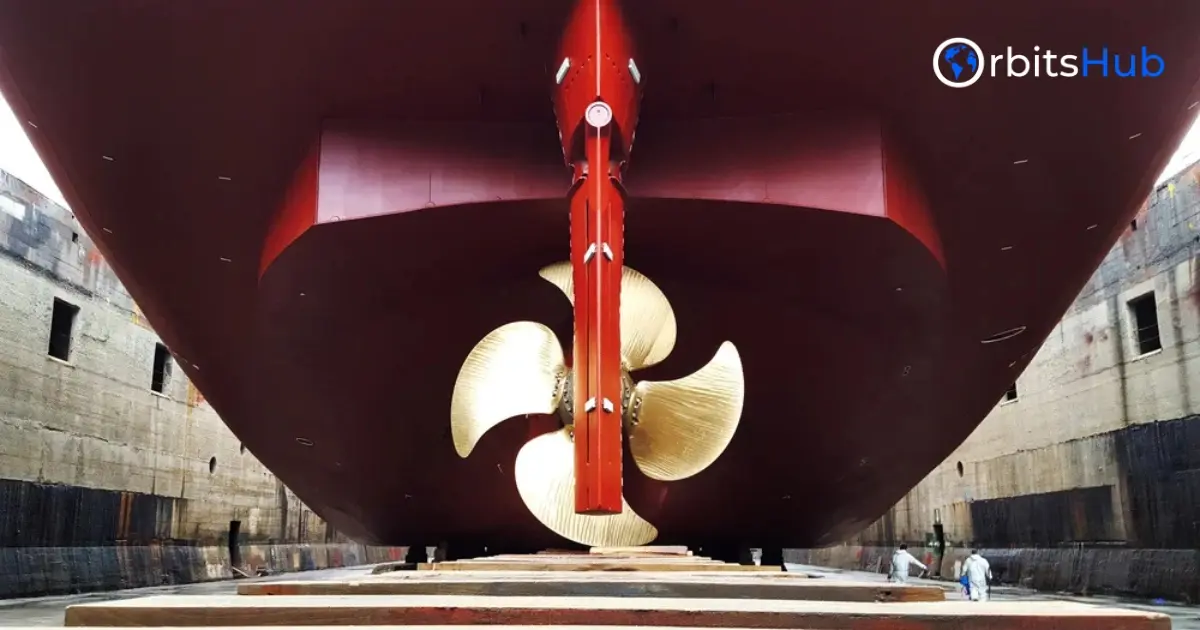
Imagine standing at the stern of a massive ocean liner, feeling the vibration beneath your feet as the engines roar to life. What’s the secret behind the incredible force that propels these floating giants across vast oceans? The answer lies in a marvel of engineering that has revolutionized maritime travel for centuries: the ship propeller.
The Heart of Maritime Propulsion
The ship propeller, often hidden beneath the waterline, is the unsung hero of maritime transportation. It’s a device so crucial that without it, our modern global trade system would grind to a halt. But what precisely is a ship propeller, and how does it function?
A ship propeller is a type of fan that transmits power by converting rotational motion into thrust. It does this by creating a difference in pressure between its blades’ front and back surfaces as it spins through the water. This pressure difference generates a force that moves the ship forward or backward, depending on the direction of rotation.
“Give me a fulcrum, and I shall move the world,” said Archimedes. Give a ship a propeller, and it shall navigate the world!
A Journey Through Time
The story of the ship propeller is a testament to human ingenuity and perseverance. It spans millennia, from ancient civilizations to modern marvels of engineering.
The Ancient Roots
Would you believe that the concept of the ship propeller dates back to ancient times? The Archimedes’ screw, invented around 200 BC, is considered the earliest predecessor of the modern ship propeller. Primarily used for irrigation, this device demonstrated the fundamental principle that would later revolutionize maritime propulsion.
The Age of Sail and Steam
Fast forward to the 19th century. The world was on the cusp of a maritime revolution. Steam engines were beginning to challenge the dominance of wind power, but there needed to be a link: an efficient way to convert the engine’s power into forward motion in water.
Enter the pioneers of propeller design. In the 1830s, inventors like John Ericsson and Francis Pettit Smith were racing to perfect the screw propeller. Their innovations would soon render paddle wheels obsolete and usher in a new era of maritime technology.
“The day when we can design a ship’s propellers with the same certainty that we design its engines will mark the beginning of a new era in shipbuilding,” predicted naval architect David Taylor in the early 20th century.
The Anatomy of a Modern Marvel
Today’s ship propellers are marvels of engineering, far removed from their humble beginnings. Let’s dive into what makes a modern ship propeller tick.
Size Matters
When it comes to ship propellers, size matters! The most enormous ship propellers in the world are genuinely awe-inspiring. Did you know that some can measure up to 30 feet (9.1 meters) in diameter? That’s about the height of a three-story building!
Material Magic
Bronze, stainless steel, or aluminum are the most common materials used to make modern ship propellers. Each material has its advantages:
- Bronze propellers offer excellent corrosion resistance.
- Stainless steel propellers provide superior strength.
- Aluminum propellers are lightweight and cost-effective.
The choice of material can significantly impact a propeller’s performance and longevity.
The Blade Breakdown
The number of blades on a ship propeller can vary, typically from three to seven. But why the variation? It’s all about finding the perfect balance between efficiency, vibration, and cavitation (forming vapor cavities in a liquid).
- Smaller vessels frequently use three-blade propellers due to their simplicity and efficiency.
- Four-blade propellers offer a satisfactory balance of performance and smoothness.
- Larger ships typically use propellers with five blades or more, which provide increased smoothness and reduced cavitation.
The Physics Behind the Force
Let’s delve into the intricate workings of ship propellers. It’s a fascinating interplay of physics and engineering that turns a spinning metal disc into a force capable of moving millions of tons across the world’s oceans.

Bernoulli’s Principle in Action
The ship propeller operates on the same principle that allows airplanes to fly: Bernoulli’s principle. As the propeller rotates, it creates high and low pressure on opposite sides of its blades. This pressure difference generates thrust, pushing water backward and propelling the ship forward.
The Power of Pitch
The pitch of a propeller—the distance it would theoretically travel in one complete revolution—plays a crucial role in its performance. A higher pitch can increase top speed but may reduce acceleration and fuel efficiency. Naval architects must carefully consider this delicate balance.
“Designing the perfect propeller is like composing a symphony. Every element must be in harmony to create the desired performance,” says leading propulsion systems engineer Dr. Maria Chen.
Propelling the Global Economy
The impact of ship propellers extends far beyond the realm of maritime engineering. These spinning marvels are driving the global economy.
Staggering Statistics
Let’s pause for a moment to consider some mind-boggling statistics about the shipping industry, all made possible by the humble ship propeller :