
The Rise of a Maritime Giant
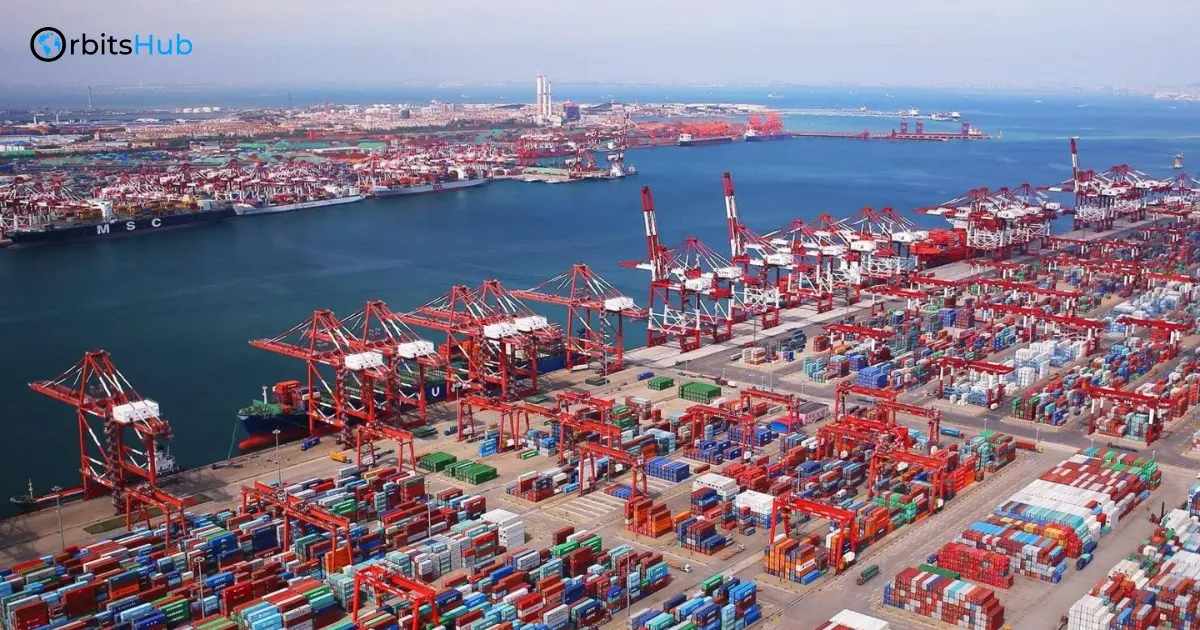
On the eastern coast of China, where the Yellow Sea meets the land, stands a testament to human ingenuity and economic prowess—Qingdao Port. With its massive cranes and endless rows of colorful containers, this bustling harbor tells a story of growth, ambition, and global connectivity.
Qingdao Port began its journey as a small fishing village. Today, it ranks among the world’s busiest ports. In 2023, it handled over 630 million tons of cargo and 23 million TEUs (Twenty-foot Equivalent Units) of containers. These numbers paint a picture of a port that never sleeps, always moving, always connecting.
A Day in the Life of Qingdao Port
Qingdao Port springs to life as the sun rises over the Yellow Sea. Massive container ships, some as long as four football fields, glide into the harbor. These sea giants carry everything from electronics to clothing, machinery, and fresh produce.
At the docks, an army of workers and machines springs into action. Towering gantry cranes, standing over 130 meters tall, reach out to the ships. They lift containers precisely, moving them from ship to shore in a carefully choreographed dance. Each day, these cranes move an average of 63,000 containers.
Behind the scenes, a sophisticated computer system coordinates this complex ballet. It tracks every container, every ship, every movement. This system processes over 1 million data points daily, ensuring that the suitable cargo goes to the right place at the right time.
The Heartbeat of Trade
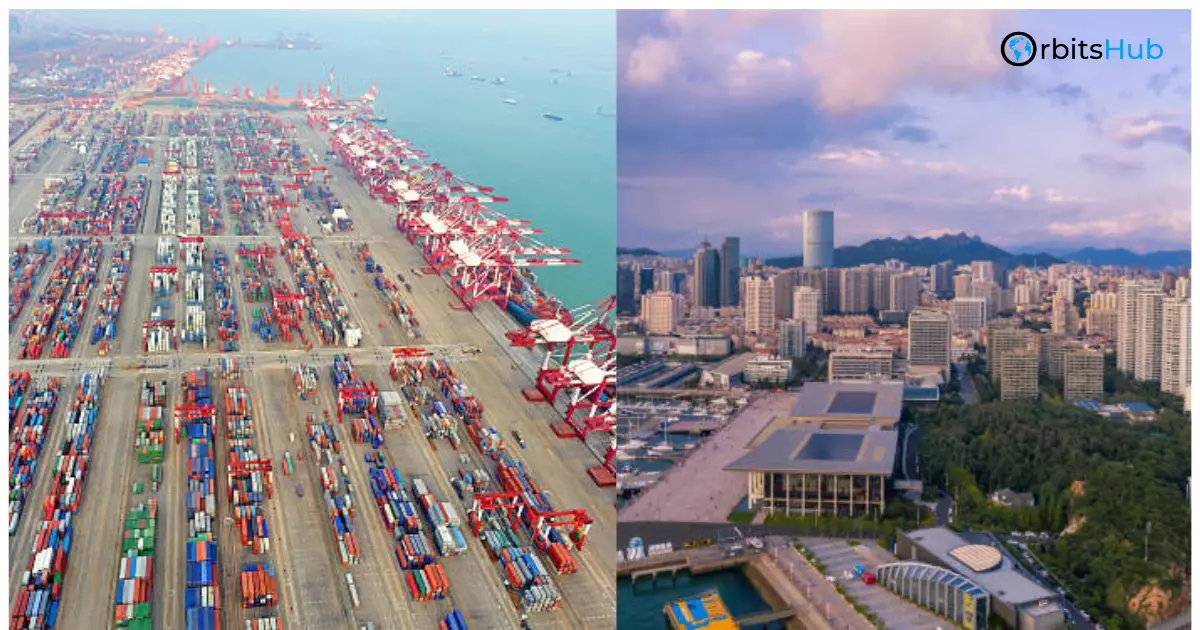
Qingdao Port serves as China’s window to the world. It connects the country’s industrial heartland to markets across the globe. From here, Chinese goods embark on journeys to distant shores—to Southeast Asia’s bustling markets, Silicon Valley’s tech hubs, and the fashion capitals of Europe.
But the port needs to send goods out. It also welcomes a flood of imports. Raw materials from Australia, machinery from Germany, and food products from the United States all find their way into China through Qingdao’s welcoming gates. In 2023, the port facilitated trade worth over $300 billion, equivalent to the GDP of a small country.
A City Transformed
The story of Qingdao Port is also the story of Qingdao City. As the port grew, so did the city around it. Today, Qingdao is home to over 10 million people. The port directly employs 50,000 workers and indirectly supports thousands more jobs in related industries.
The city’s skyline, dotted with skyscrapers and crisscrossed by modern highways, bears witness to this transformation. Yet, amidst this modernity, Qingdao retains touches of its past. The red-roofed German-style buildings in the old town serve as a reminder of the city’s colonial history, a stark contrast to the ultra-modern port facilities.
Innovation at the Forefront
Qingdao Port doesn’t just move cargo; it pushes the boundaries of what’s possible in port operations. In recent years, the port has embraced automation and artificial intelligence. Today, parts of the port operate with minimal human intervention.
Container Movement Efficiency
Environmental Impact
Automated guided vehicles (AGVs) zip around the container yards, moving containers with millimeter precision. These tireless machines work 24/7 in all weather conditions. In 2023, the port’s fleet of 200 AGVs moved over 5 million containers, a task that would have required thousands of human workers in the past.
The port is also at the forefront of green technology. It has invested heavily in shore power systems, allowing ships to plug into the electrical grid in port rather than running their diesel engines. This initiative alone has reduced carbon emissions by an estimated 50,000 tons annually.
A Link in the Belt and Road
Qingdao Port is crucial in China’s ambitious Belt and Road Initiative. This modern-day Silk Road aims to connect Asia, Europe, and Africa through ports, railways, and roads. Qingdao Port has seen its connections multiply as a critical node in this network.
In 2023, the port had regular shipping routes to over 700 ports in more than 180 countries. It also connected to China’s vast rail network, with trains departing daily for cities across Central Asia and Europe. One such train, laden with electronics and machinery, can reach Hamburg, Germany, in just 15 days—a journey that would take 40 days by sea.
Weathering Storms
Like all great endeavors, Qingdao Port has faced its share of challenges. The global financial crisis of 2008 saw trade volumes plummet. More recently, the COVID-19 pandemic disrupted global supply chains, leading to congestion and delays at ports worldwide.
Yet, Qingdao Port weathered these storms. It adapted, innovated, and emerged stronger. During the pandemic, the port implemented strict health protocols and leveraged its automation capabilities to keep goods moving. While many ports worldwide saw double-digit declines in cargo volumes, Qingdao managed to grow its throughput by 4.8% in 2020.
Looking to the Future

As Qingdao Port looks to the future, it faces both opportunities and challenges. The rise of e-commerce and the growing middle class in Asia promise increased trade volumes. At the same time, climate change and geopolitical tensions threaten global trade patterns.
The port is preparing for this future with ambitious expansion plans. A new deep-water terminal capable of handling the world’s largest container ships is under construction. When completed in 2025, it will increase the port’s capacity by 20%.
The port is also investing heavily in digital technologies. To optimize operations further, plans are underway to create a “smart port” that uses big data, the Internet of Things, and artificial intelligence. By 2030, the port aims to be fully automated and carbon-neutral.
Frequently Asked Questions
Qingdao Port covers an area of 710 square kilometers and has 156 berths. In 2023, it handled over 630 million tons of cargo and 23 million TEUs of containers.
Qingdao Port is one of the world’s busiest ports and a crucial link in global trade. It is a significant gateway for China’s imports and exports, handling over $300 billion of trade annually. The port is also a key node in China’s Belt and Road Initiative.


