Aircraft carriers are among the most formidable and strategically essential ships in the world’s oceans. These colossal floating air bases exemplify a nation’s naval prowess, projecting formidable air power across the high seas. Since their inception during World War I, aircraft carriers have solidified their position as the crown jewels of modern naval fleets, serving as indispensable assets in times of conflict and peacekeeping missions alike. As nations continue to invest in bolstering their maritime capabilities, the race to construct and maintain the largest and most advanced aircraft carriers has intensified. These behemoths showcase technological marvels and symbolize national pride, prestige, and unwavering commitment to safeguarding maritime interests.
The Top 10 Biggest Aircraft Carriers Worldwide
This comprehensive exploration delves into the world’s ten biggest aircraft carriers, ranked by their awe-inspiring displacement tonnage. Ships from the cutting-edge American juggernauts to the burgeoning Asian powerhouses are technical marvels and tributes to naval supremacy.
Gerald R. Ford Class (United States)
Reigning supreme as the largest aircraft carrier in the world, the Gerald R. Ford class boasts an astounding total load displacement of 100,000 tons. In May 2017, the US Navy received USS Gerald R. Ford (CVN 78), which became operational in December 2021 after a six-month modernization and maintenance phase.
Its 78-meter flight deck can accommodate 75 aircraft with electromagnetic launch and modern arresting gear. The Gerald R. Ford class’s 4,539 ship’s company, air wing, and support staff create naval force. American naval dominance would last decades with two A1B nuclear reactors, 250% more electrical capacity than the Nimitz class, RIM-162 Evolved Sea Sparrow missiles, Rolling Airframe Missiles, and Phalanx close-in combat weaponry.
Nimitz Class (United States): Biggest Aircraft Carrier
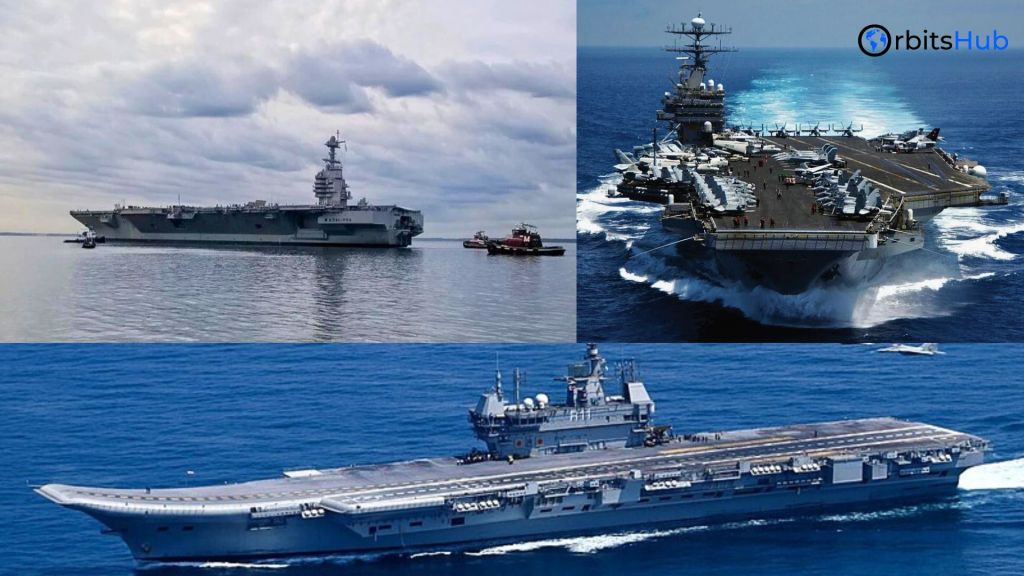
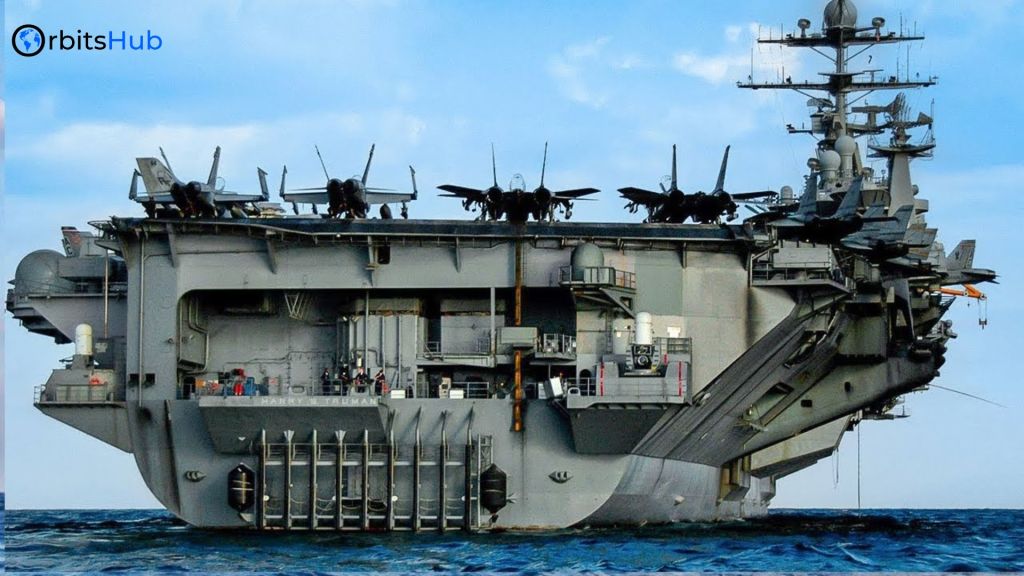
Nimitz class aircraft carriers carry 97,000 tons, making them the second-largest. It began with the USS Nimitz in May 1975 and ended with the USS George H.W. Bush (CVN 77) in January 2009. American-engineered Nimitz-class carriers have a 50-year lifespan and one mid-life upgrade. The USS George Washington (CVN 73) and USS John C. Stennis (CVN 74) are being extensively repaired to extend their service by 25 years. These 332.8-meter supercarriers have a 4.5-acre flight deck that can accommodate nearly 60 aircraft. Each 20-story ship can accommodate 5,000 people, including the corporation, air wing, and support staff. The Nimitz class, with two nuclear reactors, Sea Sparrow missiles, Phalanx close-in weapon systems, and Rolling Airframe Missiles, represents US naval superiority.
Queen Elizabeth Class (United Kingdom)
The Royal Navy’s largest warships, the Queen Elizabeth class aircraft carriers, weigh 65,000 tons and demonstrate the UK’s nautical power. In June 2017, HMS Queen Elizabeth began sea trials and was commissioned in December 2017, while HMS Prince of Wales joined the fleet in December 2019. In December 2021, HMS Queen Elizabeth completed a seven-month maiden operational deployment as the flagship of the Carrier Strike Group 21 (CSG21). The vessel showcased its global reach and endurance across three oceans and five seas.
The Queen Elizabeth class can support up to 40 rotary and fixed-wing aircraft. It incorporates cutting-edge technology and automated systems, enabling operations with a streamlined crew of 679 personnel. These carriers are powerful Royal Navy assets with Phalanx close-in weapon systems, 30mm cannons, and mini-guns for asymmetric defence. Queen Elizabeth class deploys and manoeuvres at 25 knots utilizing 109 megawatts from two Rolls-Royce MT30 gas turbines and four diesel generators.
Admiral Kuznetsov (Russian Federation)- Biggest Aircraft Carrier
Admiral Kuznetsov, the fourth largest aircraft carrier in the world, represents the Russian Navy’s power on the high seas. The only active aircraft carrier in Russia is built by Mykolaiv South.
Boasting a 14,700-square-meter flight deck, the Admiral Kuznetsov can accommodate a diverse array of aircraft, including Su-33 and MiG-29K fighters, Su-25UTG/UBP STOVL (Short Take-Off and Vertical Landing) aircraft, and a variety of helicopters such as the Ka-27S, Ka-27LD32, and Ka-27PLO.
Admiral Kuznetsov business, aviation group, and flagstaff hold 2,626. Russia’s naval power is shown by this carrier’s AK-630 anti-aircraft guns, CADS-N-1 Kashtan close-in weapon systems, P-700 Granit cruise missiles, and RBU-12000 UDAV-1 rocket launchers. To 32 knots, steam turbines power it.
Fujian (China)
Fujian, launched on June 17, 2022, at the Jiangnan Shipyard of China Shipbuilding Industry Corporation (CSIC) in Shanghai, is poised to become China’s most modern and powerful aircraft carrier. With a full-load displacement above 80,000 tons, the Fujian will redefine China’s maritime dominance. Fujian will be China’s first aircraft carrier to launch aircraft from its deck using electromagnetic catapults, surpassing Liaoning and Shandong’s ski-jump systems. This cutting-edge vessel shows China’s dedication to modernizing its naval capabilities and strengthening its maritime footprint.
Shandong (China): Biggest Aircraft Carrier

The PLAN commissioned China’s first indigenously built and second-in-service aircraft carrier, Shandong, in December 2019. Type 002, this massive ship weighs 66,000–70,000 tons. After its 2020 sea trials verified its guns, equipment, and crew training, the Shandong symbolizes China’s naval architecture advancement. After the Liaoning, the Shandong enhanced aircraft carrying capacity and superstructure design, boosting China’s naval superiority.
Liaoning (China)
The PLAN operates China’s first aircraft carrier, the Liaoning. Liaoning was a Soviet Admiral Kuznetsov class ship formerly named Riga and Varyag. China bought and refurbished the incomplete warship at the Dalian Shipyard, deploying it into the PLAN in September 2012 after an auction, an attempted conversion into a floating casino, and a transfer to Ukraine after the Soviet Union’s demise.
Armed with Type 1030 close-in weapon systems, HQ-10 missiles, and anti-submarine warfare rocket launchers, the Liaoning, with a total load displacement exceeding 58,000 tons, represents China’s first foray into modern aircraft carrier operations. Its flight deck can accommodate approximately 50 fixed-wing and rotary-wing aircraft, marking a significant milestone in China’s naval modernization efforts.
INS Vikramaditya, India’s Biggest Aircraft Carrier
Naval strength grows on 44,500-ton INS Vikramaditya, India’s largest warship. From November 2013, Moscow’s modified Kiev-class aircraft carrier is dangerous. INS Vikramaditya’s 284-meter STOBAR flight deck can accommodate 30-plus MiG-29K/Sea Harrier fighter planes, Kamov 31 and 28 helicopters, Sea King helicopters, ALH-Dhruv multirole helicopters, and Chetak utility helicopters. It possesses 60 air-to-air, guided bombs, rockets, and anti-ship missiles. Four geared steam turbines and eight turbo-pressurized boilers produce 180,000 shaft horsepower. Six turbo/diesel alternators produce 18 MW.
Charles de Gaulle (R91) (France)
The Charles de Gaulle (R91) aircraft carrier is a testament to France’s naval prowess and technological advancements. This battleship is the first French nuclear-powered surface ship and the only non-US Navy nuclear-powered carrier.
After a six-month renovation at Toulon naval station, the Charles de Gaulle supported 40 fixed-wing aircraft and helicopters in July 2013. The air wing has Rafale M multirole fighters, Super Étendard strike fighters, E-2C Hawkeye airborne early warning aircraft, SA365 Dauphin, EC725 Caracal, and AS532 Cougar helicopters.
The 42,000-ton Charles de Gaulle has 1,350 ship companies and 600 air wing troops. Nuclear-powered ship with two K15 pressurized water reactors can deploy quickly and globally at 27 knots.
INS Vikrant India Biggest Aircraft Carrier
The INS Vikrant, India’s first indigenous aircraft carrier, marked a milestone in naval self-reliance. In August 2013, this 40,000-ton yacht was launch. It completed its third sea trial in January 2022, preparing for its August 2022 commissioning.
India’s marine air force is represented by the INS Vikrant’s flight deck, which can accommodate 40 aircraft, including 26 Russian MiG-29K fighter jets. The INS Vikrant’s STOBAR gear for launching and recovering aircraft from its deck is a technological milestone for India’s defence industry. INS Vikrant’s four Otobreda 76mm dual-purpose cannons, two 32-cell vertical launching systems for Barak 1 and Barak 8 surface-to-air missiles, and AK-630 Russian fully-automatic naval close-in weapon system would deter and demonstrate India’s maritime.
Since the world’s oceans are vital for trade, energy transit, and strategic maneuverability, aircraft carriers are key to maritime power. The competition to build and maintain the largest and most advanced aircraft carriers is a monument to marine supremacy, from cutting-edge American juggernauts to China and India’s fast-growing naval forces. These massive floating air bases represent military force, national pride, technological innovation, and steadfast marine interests. Nation naval asset investments will transform aviation carrier operations and global power dynamics through innovation, strategic vision, and marine awareness.
Do you want to learn more about cutting-edge aviation and maritime technology advancements? OrbitsHub, a leading consultancy service company specializing in these domains, can be your one-stop shop. Explore OrbitsHub to discover how their expertise can empower your organization.