Orbitshub

What is a Sextant and How Does it Work?

Need Equipment Or Services For Your Ship?
what-is-a-sextant-and-how-does-it-work

A sextant is a precision optical instrument used primarily in maritime and celestial navigation. Its name derives from the Latin word “sextans,” meaning “one-sixth,” as its arc typically spans 60 degrees, or one-sixth of a circle. A sextant’s main use is to measure the angle that separates a celestial body—like the sun, moon, or stars—from the horizon. This angle helps navigators establish their latitude and longitude when at sea.

Orbitshub banner

How Does a Sextant Work?
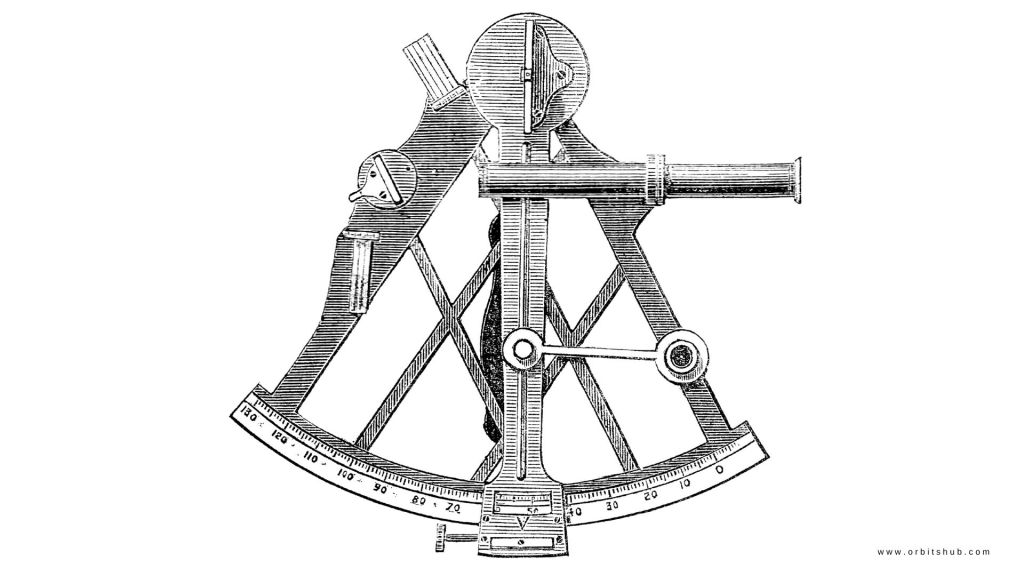
At its core, a sextant is a precision instrument designed to measure angles. It consists of a graduated arc, a movable arm called an index arm, and a system of mirrors. By aligning the index arm with a celestial body (such as the sun, moon, or a star) and the horizon, the navigator can measure the angle between them. This angle, along with the time of day and other data, can then be used to calculate the ship’s latitude and longitude.

At its core, a sextant operates on the principle of double reflection. Here’s a simplified breakdown of its key components and how they function together:

Frame: The main body of the sextant, usually made of brass or aluminum.
Arc: A graduated scale, typically marked in degrees and minutes.
Index arm: A movable arm that rotates along the arc.
Index mirror: A fully reflective mirror attached to the index arm.
Horizon mirror: A half-silvered mirror fixed to the frame.
Telescope: Used to view the horizon and celestial body simultaneously.
Shade glasses: Filters to protect the eyes when observing bright objects like the sun.

When using a sextant, the navigator looks through the telescope at the horizon. They then move the index arm, which adjusts the index mirror, until the reflection of the celestial body appears to touch the horizon in the horizon mirror. The angle between the two objects can then be read off the graduated arc.

Types of Sextants

types-of-sextants (1)

When you think of sextants, the image of a weathered sailor peering through a brass instrument might come to mind. But the world of sextants is surprisingly diverse. While the basic principle remains the same, sextants have evolved over time to suit different needs:

Traditional Marine Sextants: The classic design used in maritime navigation, typically made of brass or aluminum.
Bubble Sextants: Developed for aviation, these use an artificial horizon created by a bubble level, allowing for celestial navigation when the natural horizon isn’t visible.
Plastic Sextants: Lightweight and affordable, these are often used for education or as backups.
Digital Sextants: Modern versions that incorporate electronic sensors and displays for easier readings.

Each type has its pros and cons in terms of accuracy, durability, and ease of use. Traditional marine sextants remain the most reliable for serious navigation, while digital versions offer convenience at the cost of potential electronic failure.

Practical Applications

practical-applications

While GPS has largely supplanted celestial navigation in everyday use, sextants remain relevant in several areas:

Maritime Navigation: Sextants serve as a reliable backup to electronic navigation systems on ships. They provide a way to determine a ship’s position if GPS signals are lost or disrupted, ensuring safe navigation in any circumstance.

Celestial Navigation: For traditional navigators and astronomers, sextants are essential tools. They are used to measure the angles between celestial bodies and the horizon, allowing for the calculation of latitude and longitude for positioning.

Land Surveying: Although less common today, sextants historically played a role in land surveying. They were used to measure angles and distances between landmarks, contributing to accurate mapmaking and land demarcation.

Emergency Navigation: In emergency situations where electronic navigation systems fail or are unavailable, such as during power outages or equipment malfunctions, sextants can be lifesavers. They provide a means to navigate safely back to shore or to a safe location.

Modern Sailors’ Perspective:

The quote from Sir Robin Knox-Johnston, a renowned sailor, highlights the value placed on sextant skills by experienced mariners. Sextants are seen as a reliable and self-sufficient tool that can be depended upon in critical situations, making them an “ultimate backup” in the world of navigation.

Advantages and Limitations

advantages-and-limitations

In the heart of navigation, a timeless debate persists between the traditional sextant and the modern GPS. Each tool brings unique strengths and limitations to the table, making the choice between them a matter of context and preference.

Sextant Advantages:

Reliability: Sextants are self-contained and don’t rely on external signals or power sources, making them immune to technological failures or disruptions.

Global Coverage: Unlike GPS, which might have limited coverage in certain areas, celestial navigation with a sextant works anywhere on Earth with a clear view of the sky.

Accuracy: When used correctly and with proper calculations, sextants can provide highly accurate position information.

Skill Preservation: Using a sextant helps maintain and pass down traditional navigation skills, which are valuable for historical and practical reasons.

Sextant Limitations:

Weather Dependence: Sextant use requires clear skies to observe celestial bodies and a visible horizon for reference.

Learning Curve: Mastering sextant navigation takes significant time and practice, unlike the user-friendly interface of GPS.

Convenience: GPS offers instant position updates and easy-to-use navigation tools, making it more convenient than the manual calculations required for sextant navigation.

Error Potential: Sextant readings can be affected by weather conditions, instrument errors, and user mistakes.

The Choice:

The decision between a sextant and GPS depends on the specific context and priorities. GPS is undeniably convenient and accurate in most situations, but the sextant’s reliability and independence make it a valuable backup and a way to connect with traditional seafaring skills.


How to Use a Sextant: Basic Steps

While the sextant may appear complex at first glance, its operation follows a logical sequence. Let’s break down the essential steps to unlock the secrets of celestial navigation.

Hold the sextant vertically: This ensures accurate alignment with the horizon, which is crucial for measuring the angle of the celestial body.

Align the reflection: Move the index arm until the reflected image of the celestial body (sun, moon, star, etc.) appears to touch the horizon line as seen through the telescope.

Rock for accuracy: Gently rocking the sextant back and forth helps to find the lowest point of the celestial body’s arc, ensuring the most precise measurement.

Fine-tune with the drum/micrometer: This final adjustment brings the celestial body’s edge into exact contact with the horizon, refining the angle measurement.

Record the angle and time: Note the angle reading on the sextant’s arc and the precise time of the observation. This data is essential for later calculations to determine your position.

Common Errors:

Tilting the sextant: Holding it at an angle will skew the measurement.

Incorrect reading: The sextant’s scales require careful interpretation.

Index error: Sextants may have a slight inherent offset that needs to be accounted for.

Captain Cook’s Warning: The quote from Captain James Cook emphasizes the importance of accuracy in celestial navigation. A minor measurement error can have a big impact on your predicted position and could have hazardous maritime consequences.

Maintaining and Caring for Your Sextant

Like any precision instrument, your sextant requires diligent care to maintain its accuracy and longevity. You can guarantee that your sextant will continue to be a trustworthy friend for many years to come by following a few basic maintenance procedures. Proper care ensures your sextant remains accurate and functional:

Clean gently with a soft cloth after each use, especially if exposed to salt water.

Store in a padded case to protect from shocks and vibrations.

Regularly check and adjust the index error.

Have the instrument professionally serviced periodically.

Differences between Sextants and GPS Systems: Traditions Meet Innovation


FeatureSextantGPS System
Technology TypeAnalog, requires manual operation and visual sighting.Digital, relies on satellite technology.
Skill RequiredHigh; requires knowledge of celestial mechanics.Low; user-friendly and automated.
AccuracyDependent on skill and environmental factors.High and consistent globally.
DependenceRelies on clear skies and visibility of celestial bodies.Operates in all weather conditions.
Power SourceNone required; purely mechanical.Requires battery or electrical power source.
Data OutputProvides raw data that requires calculation.Provides direct, real-time coordinates.
PortabilityHighly portable and lightweight.Portable, but some models can be bulky.
Historical RelevanceUsed for centuries in maritime navigation.Developed in the late 20th century.
Backup UsageOften used as a backup navigation tool.Less common as a backup if functional.
Learning CurveSteep, requires practice and understanding of celestial navigation.Minimal, user-friendly interfaces.

Rooted in centuries of maritime tradition, a sextant demands human skill, celestial knowledge, and a touch of artistry. Conversely, GPS systems depend on satellites and automated algorithms for precise positioning.

Human Element

Sextants require expertise, practice, and an understanding of celestial mechanics. This human connection links modern sailors to their ancient forebears, forging a profound bond with navigational history.

Reliance on Satellites

GPS, a marvel of modern technology, operates through a network of Earth-orbiting satellites, providing instant and accurate positioning data.

The Sextant’s Modern Legacy

While GPS has largely replaced the sextant for everyday navigation, it remains an essential tool for certain applications. Naval academies and maritime training programs continue to teach celestial navigation, recognizing its value in emergency situations or when electronic systems fail. Additionally, some sailors simply enjoy the challenge and satisfaction of navigating by the stars, a timeless practice that connects them to generations of seafarers.

  1. Educational Importance: Naval academies and maritime schools continue to teach celestial navigation, ensuring future mariners understand fundamental navigation principles that predate modern technology. This preserves the knowledge and skills for future generations.
  2. Reliable Backup: Electronic systems, while advanced, are vulnerable to malfunctions and potential cyberattacks. Sextants, being manual and independent of electronic infrastructure, offer a reliable backup for navigation in such scenarios. This redundancy ensures ships can maintain course and reach their destinations safely even if technology fails.
  3. Technological Integration: Sextants are adapting to modern times by incorporating digital enhancements. These features simplify readings and calculations while preserving the core principles of celestial navigation, making sextants more accessible and user-friendly for contemporary navigators.
  4. Preserving Heritage: Sextants symbolize a rich maritime heritage and represent centuries of accumulated knowledge in celestial navigation. By continuing to use and teach sextant skills, we ensure this valuable knowledge is not lost but passed down to future generations.

The sextant stands as a testament to human ingenuity and our enduring fascination with the celestial world. From its humble beginnings to its role in charting the course of history, this remarkable instrument has played an integral part in our exploration of the seas. As we continue to navigate the complexities of the modern world, the sextant reminds us of the power of observation, knowledge, and our connection to the cosmos.

Related FAQs

A sextant is a navigation instrument used to measure the angles between celestial bodies and the horizon. It works by aligning the index mirror with the celestial body and reflecting its image onto the horizon mirror. By measuring this angle, sailors can determine their position on the Earth’s surface.

Celestial navigation remains relevant as a backup method in case of GPS failure. It also fosters a deeper connection to navigational history and offers a sense of adventure for sailors who embrace the art of navigating by the stars.

Sextants can be used both during the day and at night. During the day, navigators typically measure the angle between the sun and the horizon to determine latitude. At night, they use stars and planets for navigation.

With skilled navigators and proper corrections, sextant navigation can be highly accurate, especially for determining latitude. However, GPS is generally more precise for pinpointing exact locations with real-time data.

Common errors include atmospheric refraction, index error, and parallax. Atmospheric refraction can be corrected using tables. Index error is corrected by determining the difference between the actual index error and the reading. Parallax is minimized by ensuring that the horizon and celestial body are in the same vertical plane. Regular practice and understanding correction factors are essential for accurate readings.

Related Blogs

Leave a Reply

Your email address will not be published. Required fields are marked *