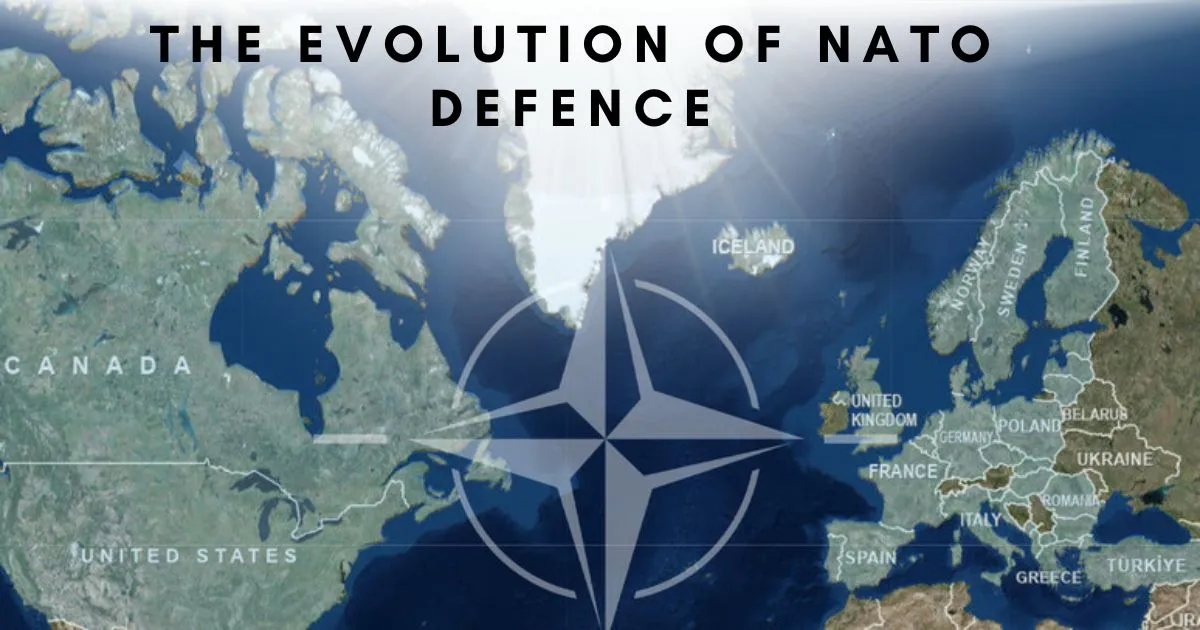
The North Atlantic Treaty Organization (NATO) has been a cornerstone of global security since its inception in 1949. To provide collective defence against potential foes, particularly the Soviet Union, the North Atlantic Treaty Organization (NATO) was established after WWII. Over the decades, NATO has evolved in response to changing geopolitical landscapes, technological advancements, and new security challenges.
The Birth of NATO Defence
The Post-War Context
In the aftermath of World War II, Europe was in ruins, and the Soviet Union emerged as a significant military power. The Cold War broke out due to the widening gulf in ideology between the Communist East and the Democratic West. To counter the growing influence and potential aggression of the Soviet Union, the Western allies recognized the need for a collective security arrangement.
The Washington Treaty
The North Atlantic Treaty, formally known as the Washington Treaty, was inked by twelve nations on April 4, 1949: the US, Belgium, Denmark, France, Iceland, Italy, Luxembourg, Norway, Portugal, the Netherlands, and Portugal. Article 5 of the treaty summarizes its primary objective: to provide mutual defence against aggression. It specifies that any armed attack on one or more NATO countries is deemed an attack on all of them.
Cold War Era: Building NATO Defence
Early Challenges and Strategic Doctrine
In its early years, NATO faced significant challenges, including differing threat perceptions among its members and the need to integrate diverse military forces. The alliance adopted a strategic doctrine focused on collective defence, deterrence, and integrating military capabilities.
The Korean War and NATO’s Military Build-Up
The outbreak of the Korean War in 1950 underscored the threat posed by communist expansionism. In response, NATO initiated a substantial military build-up, enhancing its conventional forces and establishing an integrated military command structure. A watershed moment in the history of NATO defence coordination it occurred in 1951 with the establishment of Supreme Headquarters Allied Powers Europe (SHAPE).
Nuclear Deterrence
The 1950s and 1960s saw the development of NATO’s nuclear strategy, primarily driven by the United States. The deployment of American nuclear weapons in Europe aimed to deter Soviet aggression and provide a credible defence posture. The doctrine of “massive retaliation” signalled that any Soviet attack would be met with overwhelming nuclear force.
Adapting to New Realities in NATO Defence
The Fall of the Berlin Wall and the End of the Cold War
The Cold War ended with the Soviet Union’s disintegration in 1991 and the Berlin Wall’s collapse in 1989. NATO’s primary adversary had vanished, prompting the alliance to reassess its purpose and strategy in a rapidly changing world.
Enlargement and Partnership
In the 1990s, NATO embarked on an enlargement policy, extending membership to former Warsaw Pact countries and former Soviet republics. With the admission of the Czech Republic, Poland, and Hungary in 1999—and subsequently more Eastern European nations—the goal was to foster democracy and stability in the area.
Additionally, NATO developed partnerships with non-member countries through programs such as the Partnership for Peace (PfP) and the Mediterranean Dialogue. These initiatives aimed to foster cooperation, enhance security, and address common challenges.
Out-of-Area Operations
The post-Cold War era saw NATO engage in “out-of-area” operations beyond its traditional European focus. The alliance intervened in the Balkans during the 1990s, conducting peacekeeping and stabilization missions in Bosnia, Herzegovina, and Kosovo. These operations highlighted NATO’s evolving role in crisis management and humanitarian interventions.
The 21st Century: Modernizing NATO Defence

The 9/11 Attacks and the War on Terror
Terrorist events on September 11, 2001, drastically changed the strategic environment of NATO. Article 5 was used by NATO for the first time, claiming that the attacks were an attack on all member states. This led to NATO’s involvement in the war in Afghanistan, marking its first significant mission outside Europe.
Cybersecurity and Hybrid Warfare
The 21st century has introduced new security challenges, including cybersecurity threats and hybrid warfare tactics. NATO has adapted by enhancing its cyber defence capabilities and establishing the Cooperative Cyber Defence Centre of Excellence in Estonia. The alliance also focuses on countering hybrid threats, which combine conventional and unconventional tactics, such as disinformation and cyberattacks.
The Return of Great Power Competition
In recent years, a resurgence of great power competition has occurred, particularly between Russia and China. A more robust eastern defence is necessary for NATO in light of Russia’s 2014 annexation of Crimea and the continuing tensions in Ukraine. The alliance has responded by deploying multinational battlegroups in the Baltic States and Poland and increasing its presence in the Black Sea region.
Contemporary Defence: Unity and Challenges
Enhancing Collective Defense
NATO’s core mission of collective defence remains paramount. The alliance continues to enhance its military capabilities through initiatives such as the NATO Readiness Initiative and the development of new technologies, including missile defence systems and advanced cyber capabilities.
Burden-Sharing and Defense Spending
One of the ongoing challenges within NATO is burden-sharing, particularly the equitable distribution of defence spending among member states. The United States has consistently urged European allies to increase their defence budgets to meet the agreed-upon target of 2% of GDP. Ensuring fair burden-sharing is crucial for maintaining alliance cohesion and credibility.
NATO’s Global Role
While NATO’s primary focus remains on Europe and North America, the alliance recognizes the need to address global security challenges. NATO has engaged in partnerships with countries in Asia, Africa, and the Middle East, promoting security cooperation and addressing issues such as terrorism, piracy, and regional instability.
The evolution of NATO defence is a testament to the alliance’s ability to adapt to changing security environments and emerging threats. From its origins as a collective defence pact during the Cold War to its current role in addressing global security challenges, NATO has demonstrated resilience and unity. As the world evolves, NATO’s commitment to collective defence, crisis management, and cooperative security will remain vital.
In an era of complex and interconnected threats, NATO’s role in ensuring the security and stability of its member states and beyond is more important than ever. For those interested in exploring the intricacies of maritime and aviation security, Orbitshub offers expert consultancy services to navigate these dynamic fields.
Discover how Orbitshub’s maritime and aviation consultancy services can provide the insights and solutions needed to navigate today’s complex security landscape. Visit Orbitshub for more information.