The JF-17 Thunder exemplifies modern aircraft engineering and international cooperation, sometimes called the CAC FC-1 Xiaolong. A source of national pride for the Pakistan Air Force (PAF), the JF-17 was developed in collaboration with the Pakistan Aeronautical Complex (PAC) and the Chengdu Aircraft Corporation (CAC) of China. With its speed, sophisticated electronics, and affordability, this multi-role combat aircraft was developed to fulfil the varied demands of contemporary air combat. We shall explore the JF-17 Thunder’s background, evolution, characteristics, and effects, showcasing its relevance in aviation.
History and Development: PAC JF-17 Thunder
Early Beginnings
The concept of the JF-17 Thunder originated in the late 1980s and early 1990s when Pakistan sought to develop affordable and modern fighter aircraft to replace its ageing fleet of Mirage III, Mirage V, and A-5 aircraft. The collaboration between Pakistan and China marked the beginning of this ambitious project.
Joint Venture and Design Phase

In 1999, Pakistan and China formalised their partnership, leading to the establishment of the JF-17 project. The design phase involved extensive research and development, drawing on the expertise of both nations. The primary objective was to develop a multi-purpose aircraft capable of air-to-air and ground attack missions.
First Flight and Initial Production
The JF-17 Thunder made its maiden flight on August 25, 2003, in Chengdu, China. This successful test flight marked a significant milestone in the project. Subsequent test flights and evaluations were conducted to refine the aircraft’s performance and capabilities. In 2007, the Pakistan Air Force inducted the first batch of JF-17s into its fleet, signifying the beginning of a new era in its aerial combat capabilities.
Features and Specifications: PAC JF-17 Thunder
Airframe and Design
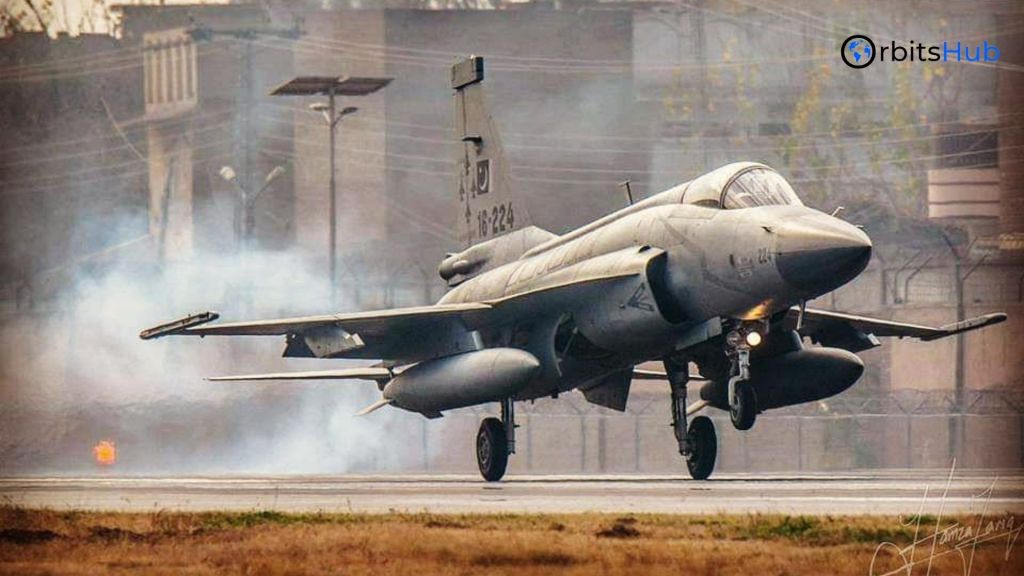
The JF-17 Thunder features a sleek and aerodynamic design, optimised for agility and manoeuvrability. The airframe is constructed using lightweight materials, ensuring a high thrust-to-weight ratio. Its single-engine configuration, powered by the Russian RD-93 engine, provides impressive performance, enabling the aircraft to reach speeds up to Mach 1.6.
Avionics and Sensors
One of the standout features of the JF-17 Thunder is its advanced avionics suite. The aircraft has a modern glass cockpit, incorporating digital displays and state-of-the-art navigation systems. The radar system, developed by China, offers excellent target acquisition and tracking capabilities, enhancing the aircraft’s combat effectiveness.
Armament and Weaponry
The JF-17 Thunder is designed to carry many munitions, making it a formidable opponent in air-to-air and air-to-ground missions. Its weaponry includes:
- Beyond-visual-range (BVR) missiles.
- Short-range air-to-air missiles.
- Precision-guided bombs.
- Unguided munitions.
This diverse arsenal ensures the JF-17 can quickly adapt to various combat scenarios.
Performance and Range
With a combat radius of approximately 1,350 kilometres and a maximum range of around 3,000 kilometres, the JF-17 Thunder offers impressive endurance for extended missions. Its high manoeuvrability and advanced avionics allow it to perform complex aerial manoeuvres, providing a tactical advantage in dogfights.
Operational History: PAC JF-17 Thunder
Induction into the Pakistan Air Force

Since its induction, the Pakistan Air Force (PAF) has been the primary operator of the JF-17 Thunder. The aircraft has greatly aided in improving the PAF’s operational capabilities. It has proven its worth in a variety of combat situations by its participation in multiple military drills and operations.
Combat Experience
The JF-17 Thunder has been involved in several conflicts, including counterterrorism operations and border skirmishes. Its versatility and reliability have made it valuable in maintaining air superiority and conducting precision strikes against hostile targets.
International Deployments
The JF-17 Thunder has attracted interest from various nations, including the PAF, where it is now serving. Many countries are considering purchasing the plane due to its sophisticated technology and cost-effectiveness. The JF-17 is already famous all over the globe, but its acquisition by both Myanmar and Nigeria has brought it even more fame.
Impact and Significance
Strengthening National Defence
The development and deployment of the JF-17 Thunder have significantly bolstered Pakistan’s national defence capabilities. By reducing dependence on foreign suppliers for advanced combat aircraft, Pakistan has achieved a degree of self-reliance in its defence sector. This achievement has enhanced the country’s military strength and boosted its technological and industrial base.
Economic Benefits
The JF-17 project has had a positive economic impact, creating jobs and fostering technological innovation. The collaboration with China has facilitated the transfer of knowledge and expertise, contributing to the growth of Pakistan’s aerospace industry. Additionally, the JF-17’s export potential has opened new avenues for revenue generation, further supporting the national economy.
Diplomatic and Strategic Influence
The successful development and export of the JF-17 Thunder have enhanced Pakistan’s diplomatic and strategic influence. Pakistan has strengthened its ties with countries seeking to modernise their air forces by offering an affordable yet capable combat aircraft. This has increased defence cooperation and strategic partnerships, elevating Pakistan’s standing in the international community.
Future Prospects: PAC JF-17 Thunder
Upgrades and Enhancements
The JF-17 Thunder programme continually evolves, with ongoing efforts to upgrade and enhance the aircraft’s capabilities. Future variants will feature improved avionics, more powerful engines, and advanced weapon systems. These upgrades will ensure that the JF-17 remains a competitive and relevant platform in the ever-changing landscape of aerial warfare.
Expanding Export Market
As more countries recognise the value proposition of the JF-17 Thunder, its export market is likely to expand. The aircraft’s affordability and advanced features make it an attractive option for nations seeking to modernise their air forces without breaking the bank. This growing demand will further solidify the JF-17’s legacy as a successful export-oriented fighter jet.
Joint Development Initiatives
The success of the JF-17 Thunder has paved the way for potential joint development initiatives between Pakistan and China. Both nations will likely continue collaborating to develop next-generation aircraft and defence technologies. These initiatives will not only strengthen bilateral ties but also contribute to the advancement of aerospace capabilities in both countries.
The JF-17 Thunder has undoubtedly left an indelible mark on the world of aviation. From idea to fact, it shows how powerful it can be for people from different countries to work together and use new technology. As a symbol of national pride and a testament to modern engineering, the JF-17 is a cornerstone of Pakistan’s aerial defence capabilities. With its impressive features, combat-proven performance, and expanding global footprint, the legacy of the JF-17 Thunder is poised to endure for years to come.
Explore the fascinating world of aviation and defence at Orbitshub, your go-to maritime and aviation consultancy source. Explore our vast collection of articles and tips to stay updated on the latest changes in your field.