The V-2 rocket, a product of World War II Germany, holds a unique and complex place in history. Though designed as a weapon of terror, its innovative technology catalyzed the dawn of the Space Age. This guide explores the history of the V-2, from its creation to its disastrous effects and surprising significance in sending humans into space.
From A4 to V-2 Rocket: A Tumultuous Development
The V-2 rocket originated with the A4 project, initiated by the German Army in the 1930s. Wernher von Braun, a young and ambitious engineer, spearheaded the project. He envisioned a long-range, ballistic missile capable of delivering payloads over vast distances.
The A4 faced numerous challenges. Building a robust and reliable liquid-fueled engine proved difficult. Early prototypes suffered from instability and catastrophic failures. Additionally, the project was plagued by resource shortages and political interference.
Despite these hurdles, the A4 project was successfully launched in 1937. However, its range and payload capacity fell below expectations. The German military, eager for a more potent weapon, renamed the project V-2 (Vergeltungswaffe-2, meaning Retaliation Weapon 2).
Terror from the Skies: The V-2’s Destructive Legacy
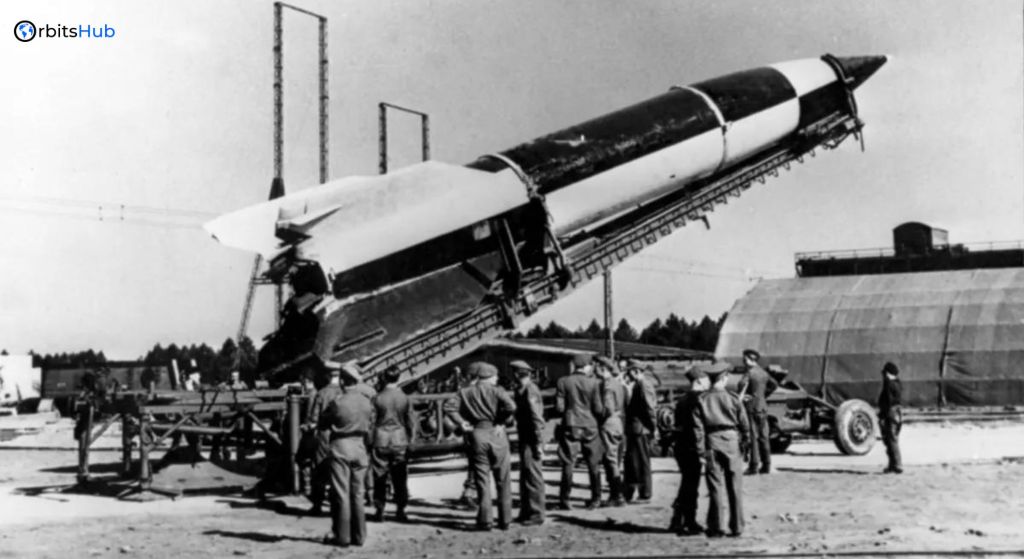
In 1944, the V-2 became operational. Launched from mobile launchers and concrete bunkers, these rockets rained down on Allied cities, primarily London and Antwerp. The V-2 was a terror weapon – supersonic, unpredictable, and carrying a massive warhead. While its accuracy was limited, its psychological impact was immense.
However, the V-2’s impact extended beyond civilian casualties. Its production relied heavily on forced labour in concentration camps, leading to the deaths of thousands of innocent people. This dark aspect of the V-2 story cannot be ignored.
A Race to the Stars: The V-2’s Influence on the Space Race
The aftermath of World War II saw a scramble for captured V-2 technology. The Americans and the Soviets recognized the V-2’s potential as a launch vehicle for scientific exploration. This newfound focus on space exploration marked the beginning of the Space Race.
The US launched captured V-2s for research purposes, gathering valuable data on rocket performance and high-altitude atmospheric conditions. These missions paved the way for developing indigenous American rockets, like the Redstone, which would propel the first American astronauts into space.
The Soviets, too, capitalized on V-2 technology. They built the R-7 Semyorka missile on top of it, and in 1957, it launched Sputnik 1, the first artificial satellite, into orbit. This historic event ignited the Space Race, a fierce competition between the US and the USSR for dominance in space exploration.
The V-2 Rocket Technological Innovations
The V-2, though a weapon of war, incorporated several revolutionary technologies that laid the groundwork for modern rockets. Here are some key innovations:
- Liquid-Fueled Engine: Unlike earlier rockets that relied on solid fuel, the V-2 used a powerful liquid-fueled engine, offering greater thrust and control. This technology is still used in modern missiles.
- Guidance System: The V-2 employed a rudimentary gyroscopic guidance system to maintain its trajectory during flight. This paved the way for more sophisticated guidance systems used in modern rockets.
- Fin Stabilization: The V-2 used fins to stabilize its aerodynamics during flight. This concept remains a fundamental principle in rocket design.
These innovations and the knowledge gained from captured V-2s became stepping stones for developing more powerful and sophisticated rockets that would propel humanity to the moon and beyond.
From Weapon to Wonder: The V-2’s Lasting Impact

The V-2 rocket is a stark reminder of humanity’s capacity for destruction and innovation. Its story serves as a cautionary tale and a source of inspiration. As we continue to explore the cosmos, let us learn from the past and strive to use the power of science for the betterment of humankind.
Explore More with OrbitsHub
Are you intrigued by the history of space exploration and its connection to the maritime and aviation industries? Visit OrbitsHub Website! OrbitsHub, a maritime and aviation consultancy, offers a wealth of information and insights into the ever-evolving world of transportation and exploration. Explore their website to learn more about the latest advancements and the fascinating intersection of these sectors with the final frontier.