Setting Sail into Supremacy
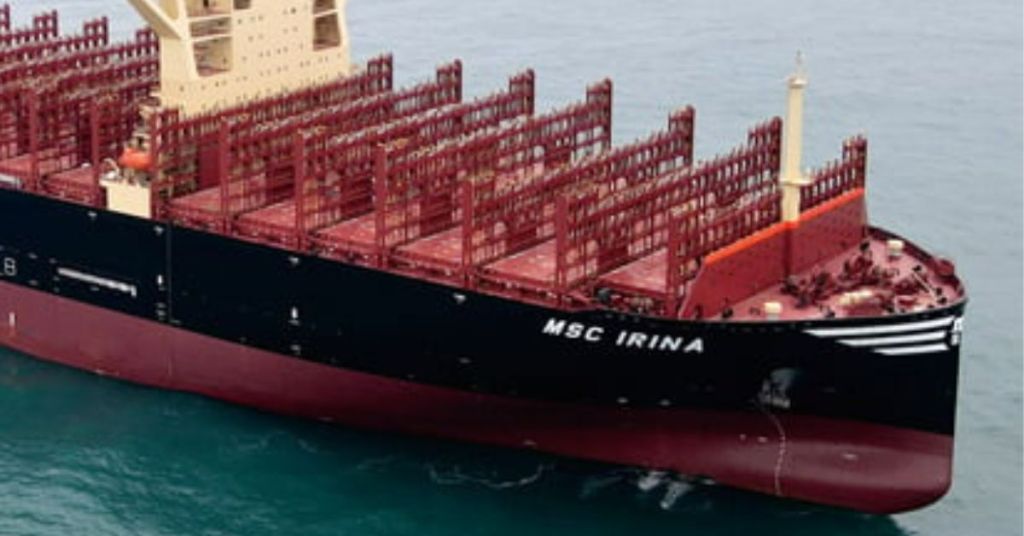
In a world where size matters, the MSC Irina proudly claims its throne as the largest container ship globally, boasting a staggering capacity of over 24,300 TEUs (twenty-foot equivalent units). To put this into perspective, that’s like fitting a small city’s worth of cargo into a single vessel. This ultra-large ship is the shining result of MSC’s ambitious endeavors and one among the many ordered by this maritime giant.
Birth of a Giant

The tale of the MSC Irina begins with its construction in 2023, a feat orchestrated by the skilled hands of the Chinese Jiangsu Yangzijiang Shipbuilding Group. Under the Liberian flag, this maritime masterpiece stretches an impressive 399.9 meters in length, almost rivaling the height of some of the world’s tallest buildings. Its breadth, measuring approximately 61.3 meters, exemplifies the sheer engineering prowess required to navigate the oceans.
Container Tetris on the Seas
Picture stacking 24,300 standard 20-foot shipping containers, reaching an astounding depth of 26 containers high. That’s the mind-boggling capacity of the MSC Irina. It’s akin to a colossal game of container Tetris, where precision and engineering brilliance rule the waves. Moreover, this marvel of maritime technology is also an eco-warrior, emitting 3-4% less carbon compared to its counterparts, a nod to sustainability amidst the vast expanse of the ocean.
From Blueprint to Reality
The journey from concept to reality for the MSC Irina commenced in November 2021. Dock assembly unfurled its grandeur in June of the following year, a sight that surely mesmerized the onlookers. As if revealing a hidden secret, the ship floated for the first time on a warm August day, an event that marked the world’s introduction to its new maritime sovereign. The ship finally left the shores for its maiden voyage in early March of 2023.
A Voyage of Giants
The MSC Irina’s inaugural voyage unfurls like a story of exploration and conquest. From its Qingdao origin, it navigates the seas to Busan before circling back to its homeland, tracing a route through Singapore, Italy, and Spain via the iconic Suez Canal. As it homeward-bound, it pays a visit to the ports of Saudi Arabia and the United Arab Emirates, truly a voyage of giants through the heart of the global trade network.
Mighty Specifications
The numbers behind the MSC Irina paint a portrait of its sheer enormity:
- Deadweight: 240,000 DWT
- TEU: 24,346
- Length: 399.9 meters (1,312 feet)
- Beam: 61.3 meters (201.1 feet)
Remarkably, while its length and width might mirror those of its counterparts, it’s the ship’s immense capacity that sets it leagues apart. It outshines its predecessor, the OOCL Spain, by a staggering 150 TEUs, a testament to human ingenuity and determination.
Unveiling MSC – The Maritime Powerhouse
At the helm of this maritime revolution is the Mediterranean Shipping Company S.A. (MSC), a Geneva-based container liner company that orchestrates global trade like a symphony. MSC brings business and connectivity to the seas with 675 offices and 730 vessels in 155 countries. This marine titan navigates over 260 trade routes with 4.6 million international standard container units (TEUs), boosting the global economy.
Engineering Marvels of the High Seas
The largest cargo ship in the world‘s design and construction is an outstanding example of contemporary engineering. These vessels are not just big; they are engineering marvels that push the boundaries of what’s possible on the open seas. The complexity of building a ship of this size involves advanced materials, cutting-edge technology, and precise planning. Engineers must consider everything from the ship’s structural integrity to its hydrodynamics, ensuring it can carry massive loads while maintaining stability and efficiency.
These ships have state-of-the-art navigation and safety systems, allowing them to traverse the world’s oceans with minimal environmental impact. The engines used are often among the most powerful in the world, designed to optimize fuel consumption and reduce emissions. Furthermore, the construction process is a feat of logistics, usually involving shipyards and suppliers from multiple countries working harmoniously to create these giants. The result is a ship that can carry thousands of containers, facilitating global trade on an unprecedented scale. The engineering prowess displayed in these vessels makes them functional and showcases human ingenuity at its finest.
Navigating the Waves of Innovation
The journey to create the most giant cargo ship in the world is a testament to the relentless pursuit of innovation in the maritime industry. Navigating the waves of innovation involves overcoming numerous challenges, from design and materials to propulsion systems and sustainability. Modern features in every modern ship include advanced GPS and navigation systems, automated systems for loading and unloading cargo, and creative hull designs that minimize drag and increase fuel efficiency.
One of the most significant areas of innovation is in the propulsion systems. Modern cargo ships are increasingly fitted with hybrid or fully electric engines, significantly reducing their carbon footprint. Additionally, AI and machine learning advancements are being integrated into the ship’s operational systems, allowing for predictive maintenance and optimized route planning, further enhancing efficiency and safety. Maintaining competitiveness and satisfying the changing needs of international trade and environmental standards depend on this ongoing innovation. Because of the industry’s dedication to innovation, these ships are not only the biggest but also the most sophisticated, establishing new benchmarks for maritime travel in the future.
Global Trade’s Colossal Backbone

The most giant cargo ships in the world serve as the colossal backbone of global trade. These behemoths of the sea are responsible for transporting an immense variety of goods, from consumer electronics and automobiles to raw materials like oil and gas. The sheer scale of these ships allows them to carry thousands of containers, making them a critical component in the supply chains that fuel the global economy.
Their size and capacity enable economies of scale that are crucial for keeping the costs of goods on their own. By moving large quantities of products in a single voyage, these ships reduce the cost per unit of transportation, lowering the overall cost of goods for consumers. Moreover, the efficiency of these ships directly impacts the speed and reliability of supply chains. With the ability to travel long distances without refueling and dock at major ports worldwide, they ensure that products can be moved quickly and efficiently from one corner of the globe to another. As global trade expands, these cargo ships will play an increasingly vital role in connecting markets and supporting economic growth.
The Evolution of Maritime Giants
Key Focus Areas in the Blog on MSC Irina
The story of the giant cargo ships in the world is also the story of the evolution of maritime giants. Over the decades, the design and capabilities of cargo ships have evolved dramatically, driven by technological advances, changes in global trade patterns, and the increasing demands of consumers and businesses. Early cargo ships were relatively small and limited in capacity, but with each passing decade, they have grown in size, complexity, and capability.
The evolution of these maritime giants can be seen in their construction materials, propulsion systems, and overall ignition. Modern cargo ships are often constructed using lightweight, high-strength materials for more extensive and efficient vessels. Innovations in propulsion, such as the transition from steam engines to diesel and now to hybrid and electric systems, have made these ships more fuel-efficient and environmentally friendly. The vessel’s design has also improved stability, speed, and cargo handling capabilities, making it more versatile and efficient in various conditions. This evolution reflects not only the advancements in engineering and technology but also the changing needs and priorities of the global economy.
A New Era in Cargo Shipping
The advent of the most giant cargo ships in the world marks the dawn of a new era in cargo shipping. This new era is characterized by unprecedented scale, efficiency, and technological sophistication. These ships are not just larger versions of their predecessors; they represent a complete rethinking of how goods are transported across the world oc ans. With capacities exceeding 20,000 TEUs (twenty-foot equivalent units), these ships can move vast quantities of goods in a single voyage, significantly reducing shipping costs and environmental impact.
This new era also brings a renewed focus on sustainability and innovation. Shipping companies increasingly invest in greener technologies, such as LNG (liquefied natural gas) engines and advanced hull designs that minimize water resistance. Another important aspect of this new era is digitalization; ships are outfitted with advanced software systems that track everything from engine performance to weather patterns, enabling real-time modifications that maximize safety and fuel efficiency. These new-generation cargo ships will lead the way in international trade and maritime logistics as the world economy grows and changes.
The Legacy Continues
Biggest cargo ship in the world MSC Irina and other vessels like it represent innovation and opportunity as the maritime sector moves forward. Every voyage it takes redefines what humans can achieve on the boundless seas. The MSC Irina represents human ambition, engineering genius, and an insatiable curiosity. Next time you see a ship on the horizon, it may be carrying part of the world’s next maritime marvel.