The C-130J Hercules, Lockheed Martin’s versatile workhorse, continues to cement its position as a critical logistics enabler for military forces worldwide. With its unparalleled operational capabilities, this aircraft is poised to remain a pivotal asset in the skies for the foreseeable future, fueled by robust global demand that is expected to sustain its production well into the next decade.
Warfighting Readiness: The Paramount Priority: C-130J
As the United States Navy Reserve underscores, warfighting readiness is the singular and unwavering priority. Rear Admiral Luke Frost, Director of Reserve Warfare, emphasizes the C-130J’s pivotal role in achieving this objective. The aircraft’s exceptional capabilities and the industry’s production prowess are crucial factors in sustaining decisive military operations in contested environments.
A Multi-Domain Maritime Battlespace
Modern warfare transcends traditional boundaries, extending vast oceanic expanses into intricate, multi-domain maritime battlespaces. The Navy must be prepared to engage in carrier strike groups, expeditionary strike forces, submarine operations, and dispersed expeditionary advanced bases. The C-130J is a vital logistics conduit in this complex theatre, connecting widely distributed maritime terrain to sustain the fighting force.
Recapitalizing the Navy’s C-130J Fleet
Aiming to recapitalize the Navy’s C-130 aircraft by 2030, the Chief of Naval Organizations’ Navigation Strategy 2022 acknowledges the crucial need for this warfighting capability. Vice Admiral John Mustin, Chief of the Navy Reserve, spearheads this urgent initiative, consistently highlighting the need to replace ageing logistics C-130s with the advanced KC-130J variant as his top equipment priority.
A Workhorse for Distributed Logistics Operations
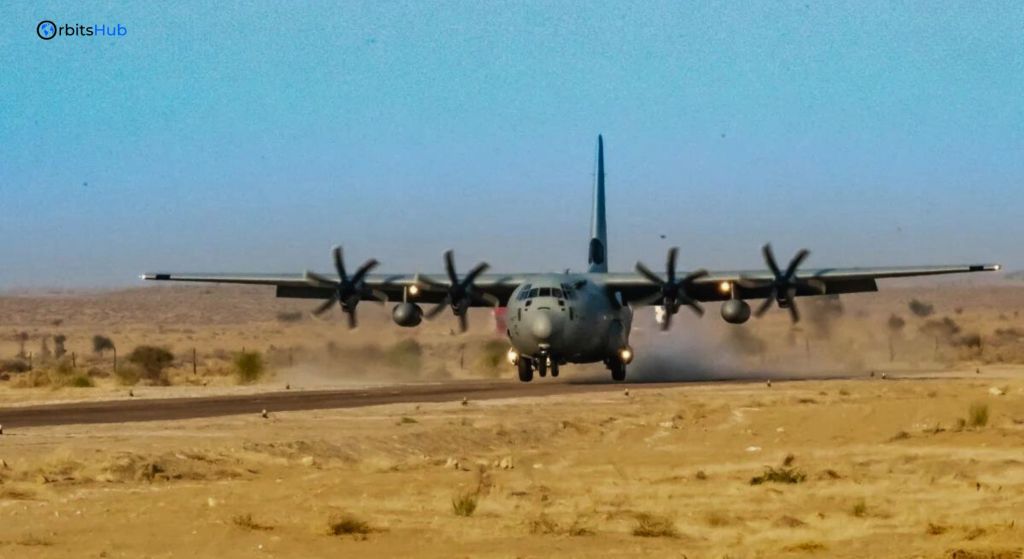
The Navy Reserve has relied on the stalwart C/KC-130T for over three decades to provide a reliable and flexible global airlift. As the workhorse of distributed logistics operations, this aircraft executes critical resupply, rearming, repair, refuelling, and revitalization missions for the fleet. From unconventional cargo to ordnance, repair parts, personnel, and essential supplies, the ‘Herc’ ensures the fleet has what it needs, when and where it’s needed, bolstering readiness and enabling rapid redeployment of naval assets.
Unmatched Operational Reach and Flexibility
The C-130’s global reach, flexibility, and ability to access unprepared airfields make it an invaluable asset for time-critical delivery of repair parts and lifesaving medical evacuations. Even as the Navy Reserve team tours Air Force Plant 6, where the C-130J is produced, C/KC-130T aircraft are actively deployed across Europe, the Indo-Pacific, and the Arabian Gulf, providing vital logistics support to the fleet.
Contested Logistics: The Forefront of Operational Priorities
Captain Damon Hildebrand, Branch Head for Reserve Enabling Requirements and soon-to-be commander of the Navy Air Logistics Office (NALO), underscores the significance of the KC-130J in sustaining operations in contested environments. With the capacity and resilience of the entire contested logistics network at the forefront, the vital importance of this aircraft cannot be overstate.
A Legacy of Excellence: Air Force Plant 6
Air Force Plant 6, the C-130J production facility, boasts a rich legacy dating back to World War II, when it produced 668 B-29 bombers. Now in its eighth decade, this plant continues to be critical for achieving the Navy’s contested logistics priorities. From its inception in 1956, when the first production of Hercules rolled off the line, to the present day, this facility has been at the forefront of advancing the C-130 platform.

A Global Collaboration: Components from Across the Nation
Final assembly and flight line preparation occurs on the Lockheed Martin factory floor in Marietta, Georgia, after engines are transported from various locations such as Mississippi, West Virginia, Virginia, and Maine. Pennsylvania, California, and Iowa receive engines, centre wing boxes, airframe components, nose cones, fuel bladders, aerial refuelling components, and fuselage panels.
Continuous Evolution and Innovation: C-130J
The C-130 has progressed and innovated, with about 2,500 units sold and used by 70 nations. With fewer crew members, the latest “J” model increases cargo capacity, range, speed, safety, dependability, and lifetime operating costs.
The “J” model is 14% faster, climbs 22% higher, has 71% better range while carrying a full payload, has 29% more takeoff thrust, and rises 40% faster than the C/KC-130T. These innovations shorten runways, increase combat access, and reduce fuel use by 15%, revolutionizing military logistics.
A Force Multiplier for Sustained Multi-Domain Combat Operations
Vice Admiral Mustin aptly states, “A Navy Reserve unit unmatched in combat readiness and prepared to fight and win in sustained, multi-domain operations is essential in this age of strategic competition.” The Navy is dedicated to equipping its fleet logistics squadrons with the most capable aircraft, including the KC-130J.
Strong International Demand and Future Prospects: C-130J
The C-130J’s global appeal is evident, with Lockheed Martin continuing to secure significant orders from international customers. Three C-130J tactical transports and three KC-model tankers joined the German Air Force at Evreux air base in France.
Germany and France have given Lockheed’s director of customer requirements for air mobility and marine missions, Larry Gallogly, encouraging comments. He also expresses Lockheed’s hope to see these nations increase the size of their fleets.
Production Adjustments and Multi-Year Procurement Agreements: C-130J
With the National Guard and Reserve C-130J procurement nearing completion, Lockheed Martin is cutting manufacturing from 24 to 20 planes. However, the company is working on a fourth multi-year procurement agreement with the U.S. Department of Defense, focusing on fulfilling the Navy’s requirements.
This arrangement supports the CNUM0J’s vital role in the U.S. military. It replaces aging CNUM1 tankers. The arrangement also possibly acquires TACAMO nuclear command aircraft (Take Charge and Move Out).

Robust Global Demand Across Continents: C-130J
The U.S. government and overseas customers, particularly in Europe and Asia, want the C-130J to replace their aging airlift fleets. Australia wants a 24-unit Foreign Military Sales deal, and New Zealand and the Philippines have contracts.
Potential Opportunities and Ongoing Assessments
Sweden offers Lockheed Martin a short-term opportunity to replace the Swedish Air Force’s C-130H Aircraft later this year. Neighboring Finland, a recent NATO member, is assessing its tactical airlift needs, presenting another potential market for the C-130J.
Operational Advantages Over Competitors
Without directly referencing Embraer’s C/KC-390, Gallogly claims the four-engine C-130J offers operational advantages over twin-engine jet alternatives. We move equipment farther and consume less fuel than a twin-engine jet “C-130J’s architecture is cost-effective and efficient, he says.
A Lasting Legacy and Continued Innovation: C-130J
As the C-130 program celebrates its 70th anniversary of initial flight, the J-model should remain popular. Gallogly emphasizes the aircraft’s relevance and Lockheed Martin’s dedication to innovation, saying production will continue well into the next decade.
According to Gallogly, Block 8.1 operational requirements currently govern deliveries “The innovation is outstanding and continues. The C-130J’s evolution is an ongoing process, ensuring it remains at the forefront of military logistics capabilities.
The Future of the LM-100J Commercial Variant
Since only Pallas Aviation and the Algerian Air Force ordered the LM-100J, Lockheed Martin delayed it. Military demand has prevented commercial C-130J orders, according to Gallogly. Global demand and Lockheed Martin innovation power C-130J Hercules military logistics. With unparalleled capabilities in a shifting multi-domain battlespace, this adaptable workhorse will assure partner forces’ readiness and combat effectiveness into the 2030s and beyond.
Need expert advice for your maritime and aviation ventures? Visit OrbitsHub and find out how our consultancy services can support your journey.