


The Dassault Rafale is a cutting-edge fighter plane that has attracted much attention in the flying world for its excellent performance and advanced features. French aerospace company Dassault Aviation designs the Rafale and has proven its worth in various missions and conflicts worldwide. This lengthy article will discuss all the fantastic things the Dassault Rafale can do. It will focus on its versatility, advanced technology, and fighting ability.
A Brief History of the Dassault Rafale
The journey of the Dassault Rafale began on July 4th, 1986, with its first flight. It was supposed to go into service in 1996, but budget cuts after the Cold War pushed back its deployment. However, after a long wait, the Rafale finally entered service with the French Navy in June 2004. Since then, it has established itself as a formidable force in the French Navy and Air Force, earning a reputation for excellence and reliability.
Versatility: The Omnirole Aircraft
One of the primary reasons behind the success of the Dassault Rafale is its extraordinary versatility. Referred to as an “Omnirole” aircraft, the Rafale can efficiently fulfill a wide range of missions. Whether air-to-air combat, air-to-ground strikes, reconnaissance missions, or nuclear deterrence, the Rafale excels in every domain.
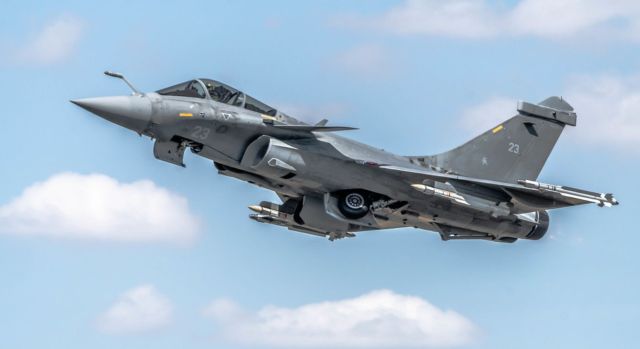
The design of the Rafale enables it to perform different types of missions, making it a truly versatile aircraft. The Rafale boasts a compact yet powerful airframe with a wingspan of 36 feet and a length of 52 feet. It can fly up to 55,000 feet and hit a top speed of Mach 2.0 thanks to its two Snecma M88-2 engines. These capabilities allow the Rafale to engage enemy aircraft effectively and conduct long-duration missions lasting over 10 hours.
Advanced Sensor Systems
Its advanced sensor systems are at the heart of the Rafale’s combat effectiveness. Equipped with a wide array of intelligent and discrete sensors, the Rafale can effectively gather and analyze crucial data to make informed decisions during missions. The aircraft’s multisensor data fusion capability allows it to combine inputs from different sensors, enhancing situational awareness and improving overall mission effectiveness.
One of the most critical sensors on the Rafale is its radar, which finds and tracks targets. The latest version of the Rafale features the RBE2-AA active antenna radar, which offers a scan area of 140° over a range of 200 kilometers. This advanced radar system enables simultaneous tracking and detecting of multiple targets, even in jammed environments and adverse weather conditions. The Rafale’s radar can also generate three-dimensional maps, providing real-time navigation assistance and precise targeting.
Weapon Systems and Mission Capabilities
The Dassault Rafale is equipped with a comprehensive range of advanced weapons, making it a formidable force in air-to-air and air-to-ground combat. Its immense carrying capacity allows it to transport substantial fuel and weaponry, enabling it to execute various missions.

The Rafale relies on the air-launched SCALP missile for air-to-ground strikes, which boasts an impressive range of over 180 miles. This long-range precision strike capability allows the Rafale to accurately engage targets deep within enemy territory. In addition to the SCALP missile, the Rafale is arm with laser-guided bombs, air-to-ground cruise missiles, and anti-ship missiles, further enhancing its ground attack capabilities.
When it comes to air-to-air combat, the Rafale is no less formidable. Equipped with advanced air-to-air missiles and a powerful cannon, it can engage enemy aircraft with exceptional precision and speed. The Rafale’s agility and high-speed capabilities give it a significant advantage in aerial dogfights, making it a force to be reckon with in the skies.
The Power of Multisensor Data Fusion
One of the key strengths of the Dassault Rafale lies in its ability to fuse data from multiple sensors, enabling a comprehensive and accurate understanding of the battlefield. By integrating inputs from radar, infrared sensors, and other onboard systems, the Rafale can build a complete picture of the operational environment, enhancing its situational awareness and decision-making capabilities.
Multisensor data fusion allows Rafale to simultaneously identify and track multiple targets, even in complex and dynamic scenarios. Data fusion enables the aircraft to prioritize threats and allocate resources effectively, ensuring optimal mission execution. This capability is particularly crucial in modern warfare, where the ability to process vast amounts of information in real-time is essential for success.
Stealth and Survivability Features
Discuss the stealth capabilities and survivability features of the Dassault Rafale, including its radar cross-section reduction measures, electronic warfare systems, and defensive aids suite. Explore how these features contribute to the aircraft’s ability to operate in contested environments and evade enemy detection and attacks.
International Partnerships and Export Success
Highlight the international partnerships and export success of the Dassault Rafale, showcasing the aircraft’s adoption by various countries beyond France. Discuss the significance of these partnerships in terms of interoperability, shared defence capabilities, and the global impact of Rafale in shaping modern air combat strategies.
Combat Proven: Deployment History
The Dassault Rafale has an impressive deployment history in various conflicts and missions worldwide. Its exceptional performance and reliability have made it a preferred choice for air forces across the globe, cementing its reputation as a combat-proven aircraft.
One notable Rafale deployment was during the Afghanistan War, where it played a vital role in numerous combat missions. From 2006 to 2011, the Rafale engaged in interceptions and precision strikes, contributing significantly to the French Air Force and Navy’s regional operations.

The Rafale also played a crucial role in the military intervention in Libya in 2011. It was the first fighter aircraft to operate over Benghazi and Tripoli, conducting precision strikes, deep strikes, and air superiority missions. The success of the Rafale in Libya further solidified its position as a reliable and effective combat aircraft.
In recent years, the Rafale has been deploy to conflict zones such as Mali, Iraq, and Syria, where it has demonstrated its versatility and combat prowess. The aircraft’s ability to adapt to different mission requirements and exceptional performance in challenging environments have made it an invaluable asset for allied forces.
Low Operating Costs and Efficiency
In addition to its exceptional combat capabilities, the Dassault Rafale offers significant advantages in terms of cost-effectiveness and operational efficiency. The plane’s design makes it possible to do many jobs with just a few aircraft. This saves the Air Force money on overall running costs.
The Rafale’s low operating costs are attribute to its versatility and adaptability. Air forces can optimize their resources and achieve operational efficiency by performing multiple missions with a single aircraft. Furthermore, the Rafale’s advanced technology and systems improve reliability, reducing maintenance and downtime requirements.
The Way Ahead: Constant Innovation
Dassault Aviation is commit to constant innovation and improvement of the Rafale, ensuring it remains at the forefront of technological advancements. The company continuously works on upgrades and enhancements to enhance the aircraft’s capabilities and maintain its competitive edge in the ever-evolving global defense landscape.
One of the ongoing developments is the implementation of the F4 upgrade, which will introduce advanced features and systems to the Rafale. This upgrade includes improvements to the aircraft’s radar, avionics, and weapon systems, further enhancing its combat effectiveness and versatility. The F4 upgrade will ensure that the Rafale remains a potent force for years.
Specifications and Performance Data
To fully appreciate the capabilities of the Dassault Rafale, it is essential to understand its specifications and performance data. The Rafale has a range of 2,302 miles and can achieve a maximum speed of 1,188 mph. With a service ceiling of 50,000 feet, the aircraft can operate at high altitudes, providing a strategic advantage regarding detection range and perspective.
The Rafale has advanced avionics and radar systems, enhancing its situational awareness and combat effectiveness. Its ability to carry various weapons, including air-to-air missiles, air-to-ground missiles, and precision-guided munitions, makes it a versatile platform for different missions. Additionally, its agility and maneuverability allow it to excel in both air-to-air and air-to-ground engagements, ensuring superiority in aerial combat scenarios.

FAQ’s
1. What is Dassault Rafale?
Dassault Rafale is a French twin-engine, multi-role fighter aircraft.
2. What are the capabilities of the Rafale?
The Rafale has “omnivore” capabilities, meaning it can perform various roles such as air-to-air combat, air-to-ground strikes, surveillance, and nuclear deterrence.
3. How fast can the Rafale fly?
The top speed of the Rafale is classified, but it is known to be capable of reaching supersonic speeds.
4. What is the stall speed of the Rafale?
The stall speed of the Rafale at close to sea level altitude is approximately 80 knots (148 km/h).
5. How many engines does the Rafale have?
The Rafale is equip with two engines, providing it with enhanced safety and performance.
6. Can the Rafale follow a fast passenger train?
Yes, the Rafale is highly maneuverable and easily keeps up with a fast passenger train.
7. Is the stall speed information publicly available for fighter aircraft?
The stall speed information for specific fighter aircraft like the Rafale may be private, as it can be consider sensitive information. However, in the case of the Rafale, the stall speed at close to sea level altitude is known.
The Dassault Rafale stands as a testament to the ingenuity and expertise of Dassault Aviation. Its versatile capabilities, advance sensor systems, and formidable weapon systems make it a force to be reckon with in modern warfare. With its combat-proven track record and ongoing technological advancements, the Rafale symbolizes excellence and innovation in the aviation industry. As air forces worldwide seek to maintain a leading role on the global stage, the Rafale remains a clear choice for those seeking a fighter aircraft that can excel in any mission.
