

The Grumman A-6A Intruder is a testament to innovation and engineering excellence in military aviation. Developed during the Cold War, this legendary plane was an essential cog in the wheel of contemporary aerial combat. From its inception to deployment, the journey of the A-6 Intruder is a fascinating tale of technological advancements and strategic imperatives.
Origins and Development of Grumman A-6A Intruder
Early Development Phases
The story of the Grumman A-6A Intruder began in the late 1950s when the U.S. Navy identified the need for a successor to its ageing fleet of attack aircraft. Grumman Aircraft Engineering Corporation, renowned for its robust aircraft designs, was awarded the contract to develop a next-generation all-weather attack aircraft.
Design Challenges and Innovations
Designing an aircraft capable of operating effectively in day and night conditions and adverse weather presented significant challenges. Grumman engineers leveraged avionics and navigation systems, including the revolutionary Doppler radar and onboard computers, to ensure precise targeting and mission execution capabilities.
Design and Technology – Grumman A-6A Intruder
Avionics and Navigation Systems
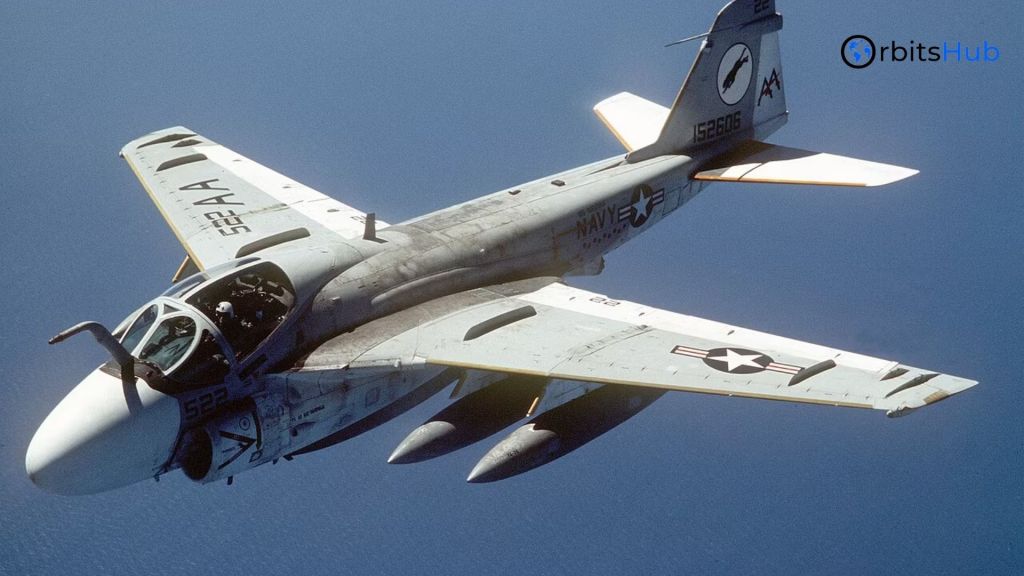
Central to the A-6 Intruder’s success was its advanced avionics suite. The incorporation of Doppler radar enabled accurate navigation and targeting in all weather conditions and facilitated low-altitude flight profiles essential for evading enemy defences.
Cockpit and Crew Integration
The A-6 Intruder featured a sophisticated cockpit layout designed for optimal crew efficiency. Its ergonomic design and intuitive controls allowed pilots and navigators to execute complex missions precisely and confidently, enhancing overall operational effectiveness.
Features and Capabilities of Grumman A-6A Intruder
Performance Metrics
Powered by twin jet engines, the A-6 Intruder achieved high subsonic speeds and extended range capabilities, making it a formidable asset for strike missions and reconnaissance operations. Its robust airframe and payload capacity enabled the carriage of various munitions, ranging from conventional bombs to cutting-edge guided missiles.
Combat Effectiveness
Deployed extensively during the Vietnam War, the A-6 Intruder earned acclaim for its reliability and mission success rates. Its ability to accurately deliver payloads was pivotal in supporting ground operations and strategic objectives, solidifying its reputation as a versatile and lethal combat aircraft.
Operational History: Grumman A-6A Intruder
Vietnam War Deployments
During its service in Southeast Asia, the A-6 Intruder conducted many missions, including close air support, interdiction, and electronic warfare operations. Its ability to operate from aircraft carriers gave the U.S. Navy unprecedented flexibility in conducting sustained combat operations deep into hostile territory.
Post-Vietnam Era and Beyond
Following the Vietnam War, the Grumman A-6A Intruder continued to serve admirably in various global hotspots and conflicts, showcasing its enduring relevance and adaptability in evolving geopolitical landscapes. Its role in naval aviation operations remained pivotal until it retired from active service.
Legacy and Impact of Grumman A-6A Intruder
Technological Advancements
The A-6 Intruder’s legacy extends beyond its operational achievements. It served as a technological trailblazer, paving the way for advancements in avionics, precision-guided munitions, and mission planning systems. Many of its innovations laid the groundwork for subsequent generations of naval strike aircraft.
Influence on Naval Aviation Doctrine
The operational concepts and tactics developed around the A-6 Intruder influenced naval aviation doctrines worldwide. Its integrated avionics suite and mission versatility set benchmarks for future naval aviation platforms, shaping the evolution of maritime strike capabilities for decades to come.
Maintenance and Reliability
Engineering Challenges and Solutions
Maintenance of the A-6 Intruder posed significant challenges due to its complex avionics and dual-engine configuration. Grumman engineers developed innovative maintenance procedures and systems to ensure operational readiness and reliability in demanding naval environments.
Operational Deployments and Missions
Cold War Era Operations
Beyond its role in the Vietnam War, the Grumman A-6A was instrumental during the Cold War, conducting reconnaissance and strike missions in response to geopolitical tensions. Its versatility and endurance made it a cornerstone of U.S. Navy strategy during this pivotal historical period.
Evolution of Avionics Technology
Advancements in Radar Systems
Developing and integrating advanced radar systems, such as the Doppler radar, significantly enhanced the A-6 Intruder’s ability to operate effectively in all weather conditions and during night missions. Explore how these technologies revolutionized naval aviation capabilities.
Impact on Naval Tactics and Strategy

Role in Integrated Strike Operations
The A-6 Intruder played a pivotal role in the evolution of integrated strike operations within naval aviation. Its ability to deliver precision strikes and conduct reconnaissance missions reshaped how navies approached combat scenarios and strategic planning.
The Grumman A-6A Intruder remains a symbol of innovation and excellence in the annals of military aviation history. From its conceptualization to retirement, this remarkable aircraft exemplifies the relentless pursuit of technological advancement and operational effectiveness. Its impact on naval warfare continues to resonate, underscoring the enduring legacy of the men and women who designed, flew, and maintained it.
Explore more about the evolution of military aviation and the technologies that shaped the A-6 Intruder at OrbitsHub. Discover how this iconic aircraft continues to inspire advancements in modern naval aviation.



Comment(01)
President Lyndon B. Johnson visited the USS Constellation (CVA-64) in 1968. This visit occurred prior to the Constellation’s fourth deployment to the Western Pacific. While conducting a fly-by for the President, the B/N in an A6A Intruder, from Attack Squadron 196 managed to eject along side the ship and was recovered, the pilot remained in the a/c and safely landed ashore. Can anyone remember who the 2 crew members were?