Geography and Location

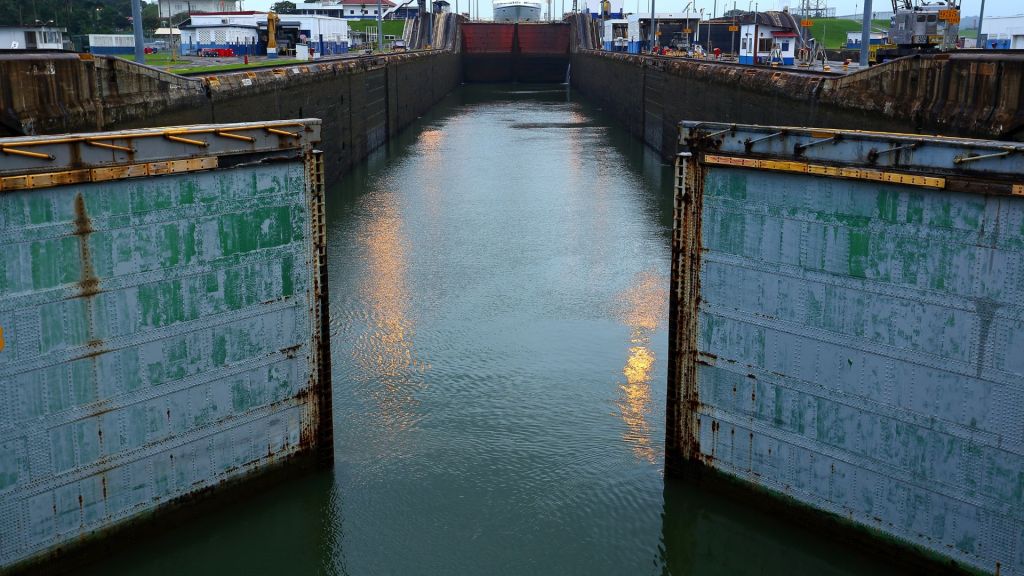
The 50-mile Panama Canal serves as an essential channel linking the Atlantic and Pacific Oceans through Panama’s slender S-shaped land bridge between North and South America. Ships approach from coastal access points on either side and pass through three sets of concrete lock complexes that function to raise and lower vessels 85 feet above sea level to the canal’s central artificial Lake Gatun section before descending back to sea level on the other coast.
Engineering Feats
Constructing the Panama Canal posed immense engineering challenges, demanding digging out over 200 million cubic yards through mountainous terrain. The canal utilizes a gravity-based lock system with release valves, side chambers, and gates allowing ships to be carefully raised to the canal’s summit lake then lowered again through a series of three stepped lock pairs on each coast.
Additionally, damming Panama’s Chagres River formed the essential Lake Gatun reservoir required for canal operation based on an ingenious hydroelectric water storage system and lake creation spanning over 164 square miles.
Impact and Signficance
Following its 1914 completion, the Panama Canal represented the world’s greatest shortcut for maritime shipping, reducing voyage times by 8,000 miles or up to 3 weeks. This dramatically lowered transportation expenses, allowing goods to be traded internationally much more cost-effectively. Consequently, global commerce flourished.
Strategically, the canal also provided the U.S. Navy with a major tactical advantage and influenced geopolitics over the past century as well. Control of such a critical Pacific-Atlantic shipping corridor held substantial military and trade power implications.
Expansions and Improvements
To bolster capacity, between 2007 and 2016 the canal underwent major enhancements costing over $5 billion dollars, adding an additional lane enabling two-way traffic and longer transit capabilities. The canal can now handle New Panamax megaships 1,200 feet long with cargo volumes up to 14,000 TEUs after new lock chambers were constructed parallel beside smaller original locks.
Operation and Management

Initially governed under United States oversight for 85 years, in 1979 control of the Panama Canal was transferred to joint Panamanian-American administration. Careful attention to scheduling, coordination, maintenance and safety has contributed to efficient passage of over 1 million ships thus far. Traffic flows are prioritized and guided by dispatchers via landlines and maritime radio with captains and specialized pilots onboard to navigate the transit.
Wildlife Preservation
Despite dividing a continent, canal authorities have demonstrated commitment to environmental initiatives like forest protection, operating research stations, and wildlife observation access to minimize ecological impacts. Considerable former canal lands have been designated nature preserves especially around Lake Gatun. Consequently, diverse flora and fauna abound along the canal including vibrant tropical bird species.
Today’s Passages and Traffic
Currently, the canal averages about 40 ship transits daily transporting over 250 million tons of cargo. Oceangoing vessel types range from private yachts to immense container ships and tankers. Though infrequent, accidents may halt operation temporarily. However, savvy emergency management protocols ensure swift response and recovery to safely restore transit flow when incidents occur. Looking ahead, canal visits may reach 25,000 ships yearly, underscoring the need for ongoing capacity scaling.
Competition and Complementary Routes
Despite offering the fastest East-West maritime shortcut, various extended trade corridors serve as transportation alternatives depending on destination ports. But for American grain, oil or manufactured goods bound for Asia, canal transit offers undeniable advantages over Cape Horn or Suez canal detours half a world away. Inversely, enormous bulk carriers often travel alternate paths bypassing canal dimensional limits. Thus complementary intermodal connections with rail, pipeline or trucking enhance canal accessibility.
Future Outlook and Vision
Substantial forthcoming investments earmarked to modernize facilities and equipment plus an added dam raising Lake Gatun bode well for the canal’s legacy of reliable operation in a 21st century shipping environment even amid unpredictable global markets and climatic shifts. Executives remain fully committed to proactive upkeep, safety improvements and responsiveness to evolving maritime demands, thus ensuring this vital Panamanian waterway continues facilitating prosperous world trade far into the foreseeable future through sustainable expansion projects and technological integration where appropriate.